
Future of Work: Making the Office Worth the Commute
International Workplace Summit 2026

What if the future of work were about giving people a rela benefit for getting back to the office? On Thursday 24 September, the first International Workplace Summit (IWS 2026) took place at the Campus Cyber in La Défense, Paris. The audience was made up of corporate real estate directors, workplace and facility managers and HR heads from all over Europe, all there to tackle what sounds like a simple question. What needs to change in the way we design and run workplaces?
It is anything but an academic question. Since Covid, the way we behave has changed, and society is shifting faster than ever. People now like to talk about a BANI world (brittle, anxious, non-linear, incomprehensible). The acronym is a blatant overstatement, but there is some truth behind it. The years before 2010 were fairly stable, and since then one disruption has followed another at breakneck speed. What we still need to give young people is a future worth working for, not just doom and gloom or a sales pitch for the latest tech. Here is my take on that morning in La Défense.
IWS 2026: Making the Office Worth the Commute
Artificial intelligence is at the heart of the future of work. We have been writing about it on Visionary Marketing since 2016, long before large language models came along and sparked something close to mass panic, helped along by the tech giants who keep telling us chatbots are about to wipe out humanity.
These predictions are overblown, as Forrester’s J.P. Gownder told us a few months ago. Still, something is clearly going on, and the IWS morning gave us three takes on it which, put together, paint a pretty full picture of the future of work. First a diagnosis, then a tech pitch, and finally a vision. And God knows we all desperately need such a vision.
Podcast (english): Play in new window | Download (Duration: 18:06 — 25.1MB)
Subscribe: Apple Podcasts | Spotify | Android | RSS
Podcast: Play in new window | Download (Duration: 18:37 — 26.2MB)
Subscribe: Apple Podcasts | Spotify | Android | RSS
Future of Work at The Campus Cyber
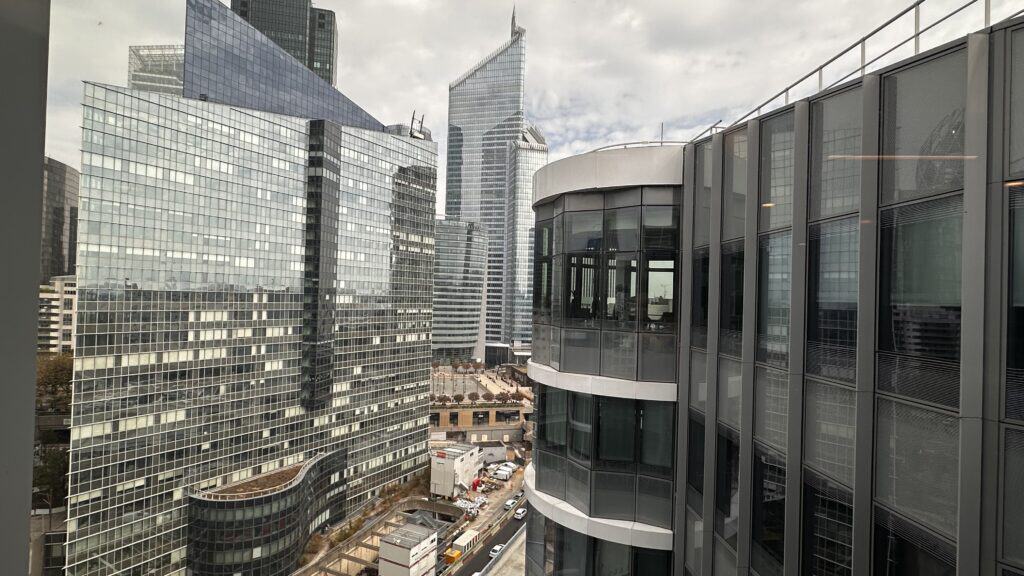
A pet project of Emmanuel Macron’s, the Campus Cyber opened on 15 February 2022 in La Défense. It sits in the Eria tower, easy to spot thanks to its petal-like shape, and is home to some 1,800 people, including teams from ANSSI, France’s national cybersecurity agency. Around a third of the building is made up of collaborative spaces open to the whole sector, where big corporations, start-ups, government agencies, schools and research labs rub shoulders.
The interior was designed by Projective Architecture, which took care of client-side project support, space planning and design and build on some 208,000 sq ft (19,300 m²) of the tower’s 280,000 sq ft (26,000 m²) and 13 floors. That includes the restaurants, a library, event spaces, a showroom and terraces.
A Former Labour Minister’s Diagnosis at IWS 2026
The former French Labour Minister, who spent earlier stints at Danone and 3DS, brought out a graphic novel on the subject in 2025 with journalist Mathieu Charrier and artist Nicoby, Travailler demain (“Working Tomorrow”, in French). She asked the audience to “zoom out” from the workplace for a moment and look at the decade ahead. As she sees it, four waves are hitting us at once. AI, going green, demographics and our changing relationship with work.
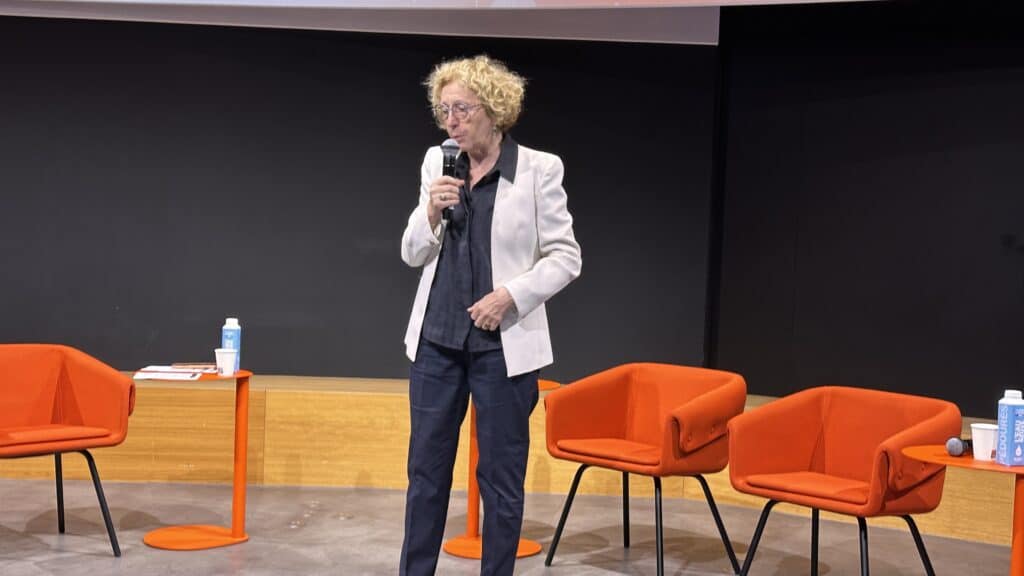
Three numbers show how big this is. According to the IMF and the OECD, AI will affect 50 to 70% of jobs in developed economies over the next ten years, and by “affect” she means “destroy, create or transform”. The World Economic Forum reckons two thirds of the jobs our kids will do don’t exist yet. The third figure is the least known and the most striking.
Since the late 1980s, the OECD has been tracking how long the skills students pick up in vocational higher education stay useful. A generation ago, the answer was thirty years. Today, it is apparently two. Muriel Pénicaud draws the obvious conclusion. The old model of studying first and working afterwards is dead, and we will all be learning for the rest of our lives.
Mind you, I have a feeling the best people have always worked that way. Is it really that new?
What Is Really New
What is genuinely new is who bears the brunt. Earlier waves of automationMarketing automation in B2B enables marketing processes to be managed automatically across multiple channels. With marketing automation, companies can target their visitors with automated messages via e-mail, the web, social networks and SMS. Marketing Automation in B2B Above is a diagram explaining how the scenarios work in marketing automation, based on behavioural scoring and profiles. Messages are sent automatically, according to sets of instructions called workflows. The Limits of B2B Marketing Automation Some companies install marketing automation mechanisms while their maturity on the subject is ‘under construction’. They deploy technology for technology’s sake which leads them to use tools that targeted factories. This one is aimed first at white-collar workers, back-office functions, finance, HR, marketing and middle management, which she calls “the glue that holds companies together”. She sees an opportunity here, getting rid of the drudgery, and a risk, losing sight of why our work matters. A large teaching hospital in Montreal shows how this can play out. It brought in AI to handle its logistics and saved around 25 to 30%. Instead of pocketing the money, management put that time back into patient care, and patients now get better faster. People came first again.
Finally, some good news.
The rest of her talk ran through the move to net zero, which “HR is still barely dealing with” (how do you retrain Silesian coal miners in a country that gets 80% of its energy from coal?), falling birth rates, with 670,000 young people about to enter the French job market against 956,000 at the peak, and remote work. The studies she quotes show that working from home boosts individual productivity but hurts creativity, problem-solving and the sense of belonging. For her, whispering into a headset in an open-plan office to talk to Singapore is pointless. If you come into the office, it should be to do things together.
All of this is spot on, well researched and pretty unsettling. Over coffee, quite a few of us were thinking the same thing. If there had been more young graduates in the room, they would have walked out believing most of what they just learned is already out of date. This kind of diagnosis, which well-informed people repeat at one conference after another, is not a vision of the future. It doesn’t make anyone want to get behind a project. Muriel Pénicaud admits as much. Young people aren’t checking out, they are just committing differently, to projects that mean something rather than to institutions. But somebody has to offer them those projects.
Futureof Work: Tom Ryckaert’s Tech Promise at IWS 2026
The second take came from Tom Ryckaert, a director at Planon, which makes real estate and facility management software, and author of Disruptive Workplaces. His argument boils down to one line. The question is no longer whether AI will help us work, but whether work will still happen in the workplace.
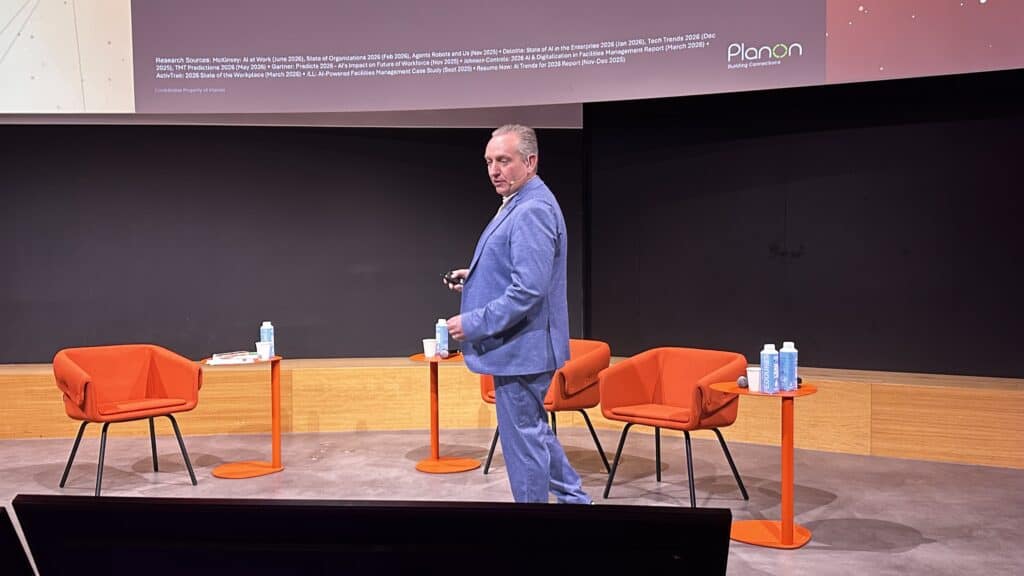
He went through it at a cracking pace. Predictive maintenance, with 40% less downtime and 25% lower repair bills, a new generation of platforms, which research firm Verdantix calls CPIPs (connected portfolio intelligence platforms), hooking building management systems up to the company’s IT. The air conditioning throws an alarm, a work order goes straight to the right contractor, and nobody in the building ever had to pick up the phone. The employee journey runs itself too. Your app warns you about a traffic jam, books you a parking space with a charger, offers you the desk next to your usual one when that is taken, and orders your Tuesday chicken poke bowl.
It’s All Here Already
All of this is already out there, Tom Ryckaert insists. Robots and cobots (collaborative robots built to work next to people without a safety cage) cost between €10,000 and €50,000 today and will soon come down to €5,000. He even dusts off “facility as a service”, an idea he was pushing ten years ago, where you call on services when you need them, just like software.
Ryckaert also reminds us that 20% of a building’s total cost is locked in at the design stage and the other 80% over decades of running it. He says we should cut “the AI elephant” into bite-sized, practical use cases instead of trying to do everything at once. Above all, he quotes Tariq Chauhan, who runs the Middle Eastern service provider EFS and told him it will always come down to people, because they are the ones keeping the services going every single day.
Yet all this accumulation of tech leaves a big question unanswered. You hear it at most trade shows, and it doesn’t really address the issues raised an hour earlier. A building that orders your lunch tells you nothing about why you are there, or why a young person who has just turned down a permanent job would ever come back. Many of the solutions on show make sense, and some are genuinely appealing. But they deal with running the building, not with meaning. The problem Muriel Pénicaud put her finger on is a societal one, almost a question of civilisation, and no connected platform is going to fix it on its own.
Ten Trends Worth the Commute
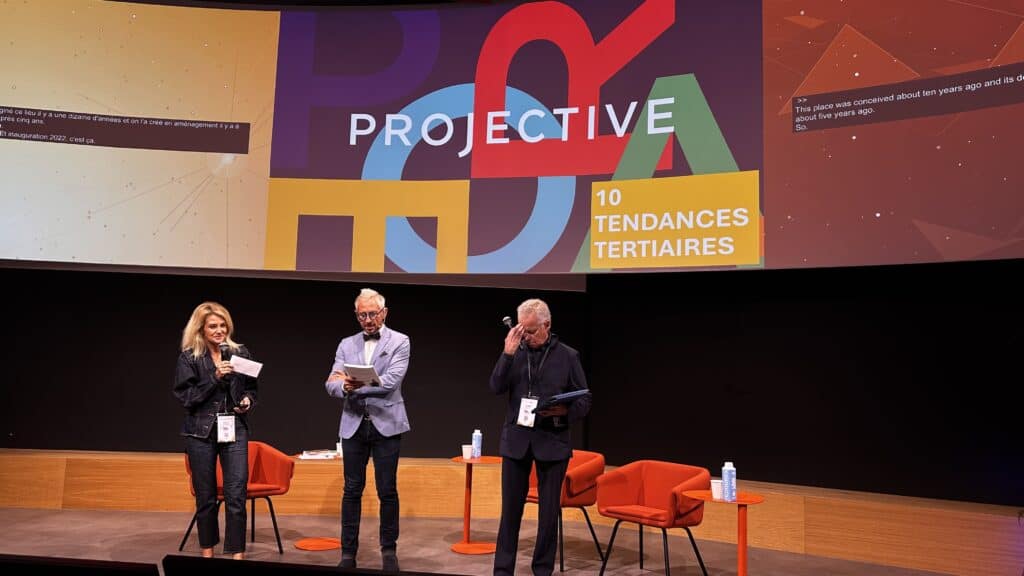
The third take came from the people who designed the very building we were sitting in. Jérôme Galletti and Carole de Crozet of Projective Architecture came up with the Campus Cyber around ten years ago and fitted it out five years ago. Rather than give us a slideshow tour, they used it to pull out what Jérôme Galletti calls “ten or so desirable trends for the future of office buildings”. That word matters. The idea is no longer to put up with an uncertain future, but to spell out what we actually want to build, and to make the office worth the commute.
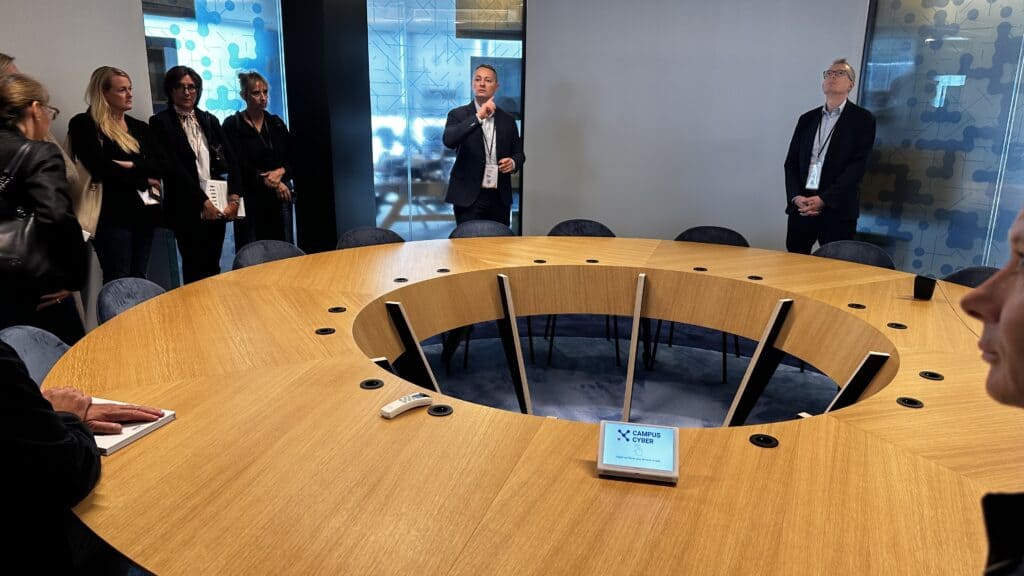
From this project and our research, we came up with ten or so desirable trends for the future of office buildings.
Jérôme Galletti, Projective Architecture
The first trend turns an old habit on its head. Office buildings are too often fortresses that turn their backs on the street. At the Campus Cyber, says Jérôme Galletti, anyone can walk in without showing ID, whether they are passing by, looking for a job or studying. They can grab a coffee, work for a few hours, catch an event and ask questions about cybersecurity. Carole de Crozet explained how the building then becomes the hub of a whole sector, where private firms, public bodies, start-ups and schools gather around the same issue, so they can work together and do business faster.
Getting people under one roof isn’t enough, you have to give them a reason to mingle. A typical office building runs a handful of events a year. The campus runs six hundred, two or three a day, with some thirty people working on nothing else. The lecture theatre built for one-way speeches gives way to a flexible hub that can host several stages, a hackathon or a dinner. The showroom full of products going back to the 1950s makes way for an innovation centre where in-house teams and clients work together on what comes next. And food is no longer just a lunchtime affair, with five different spaces that double up for client meetings, training sessions or brainstorming.
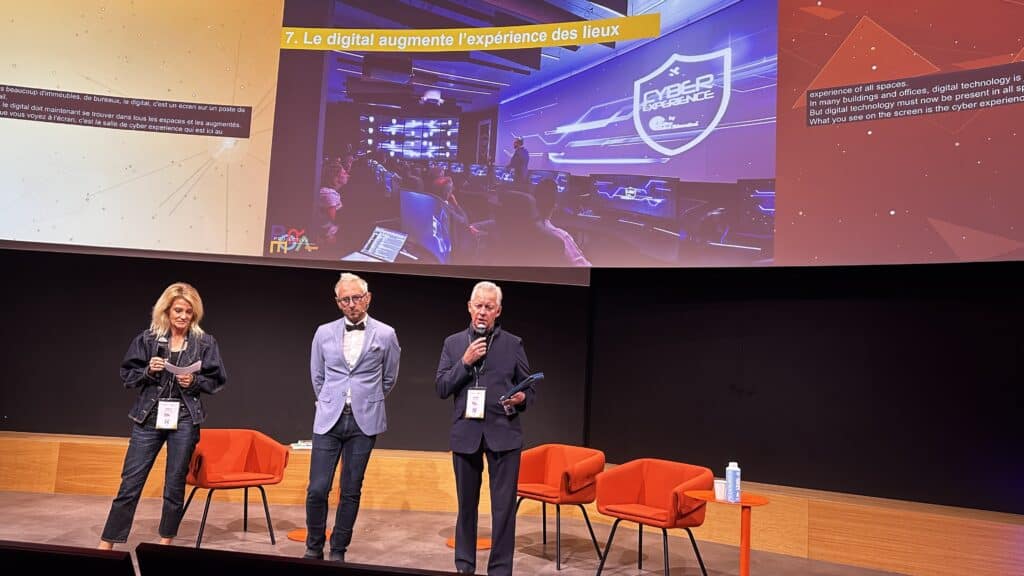
Digital is on the list, but it plays a different part.
It is no longer stuck on the screen at your desk and should add something to every space. The cyber-experience room on the third floor puts executive teams through crisis drills, with sensors that let the facilitators see how participants are holding up as the exercise unfolds. The last few trends are strikingly simple. Get rid of long corridors and turn the spaces in between into places where people actually talk and work, deal with acoustics everywhere (noise is the number one complaint in offices, and at the Campus Cyber even the ceiling decor soaks up sound), and build in flexibility from day one. The campus spaces change use as needs change, with no need to knock anything down.
What makes this talk stand out isn’t so much any single idea as the approach behind it. Technology is just one tool among many. The starting point was how people actually use the place and what they experience there. We love saying young people are disengaged, and there is some truth in it. We are far less good at giving them an experience that makes them want to turn up. Galletti and Crozet showed, in a real building we walked around straight after, that it can be done.
The Desk, From Object to Experience
The workshop on workstations brought the same thinking down to the individual desk. Alban-Michel Moreno of Ministry of Makers pointed out that ergonomics is about how the body relates to objects, but it also covers acoustics and, beyond that, the whole office experience, right down to going for a lunchtime run with colleagues. Nobody comes to the office for the kit anymore. Crédit Agricole‘s project at its SQY Park campus in Guyancourt, just outside Paris, is a good example. Staff tried out six different monitor arms themselves, on a simple principle. The people who use them know best.
Hot-desking has a catch, though. The desk doesn’t belong to anyone anymore. Everything looks the same. It is nice, clever, well thought out, and completely soulless. People don’t like using a keyboard or mouse that isn’t theirs, and Fellowes says you can’t work properly on a laptop for more than two hours. These projects only work if people make the space their own. You have to leave room for the kids’ macaroni necklace and the holiday snaps, or the office will never be worth the commute.
Future and Present of Work: From Global to Local
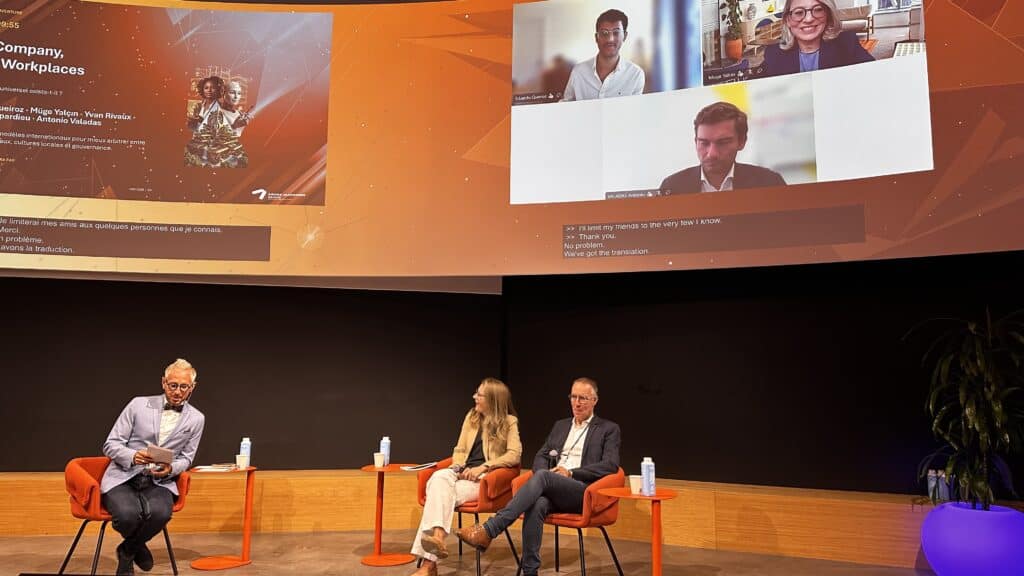
The opening round table, with Kantar, Tetra Pak, Servier, consultancy Jaicost and Korus Group talking about running sites in several countries, had already raised the issue at nine in the morning.
The speakers described a constant tug of war between global standards and local cultures, with shared rules on accessibility, sustainability and ergonomics on one side and each country’s own habits on the other. Work doesn’t look the same everywhere. And yet wherever you go, offices look strikingly similar, and the hybrid debate keeps going round in circles because nobody has really pinned down what is hybrid about these organisations.
The International Workplace Summit
IWS 2026 is a hybrid event run by Agora Managers Groupe on the initiative of trade publication Anews Workwell. Its organisers bill it as the G20 of the workplace and facility management, bringing together business leaders, policymakers, researchers, philosophers and industry players. Its tagline is “Experience the future. Now.”
ESEIS and Korus Group are its Platinum partners, alongside Planon, Jaicost, DEYA, Fellowes, MerciYanis, SaaSOffice, Smart Impulse and Projective Architecture, which also ran the building tours. Topics ranged from circular buildings and AI and robotics in smart buildings to employee experience and the regenerative workplace. The full programme is on the official website.
What the Future of Work Is Missing: an Office Worth the Commute
So the IWS morning gave us, in that order, a clear-eyed diagnosis, a whole lot of tech and a proposal. We need the first two. Muriel Pénicaud is right that uncertainty is now the only certainty, and Tom Ryckaert was right to remind us that the tools to run buildings on autopilot are here. But neither of them is enough to get teams on board, let alone a generation that puts meaning ahead of job security.
And by the way, Gen Z doesn’t have a monopolyMarket definition in B2B and B2C - The very notion of "market" is at the heart of any marketing approach. A market can be defined... on wanting work to mean something. According to Apec, the French executive employment agency, 95% of managers of all ages say it matters to them that their job makes sense. Another survey, by marketing research company Ifop in January 2023, found that only 21% of French workers see work as “very important” in their lives, down from 60% in 1990. That figure is 21% for 18-24 year-olds and 23% for 50-65 year-olds, barely any gap between generations (source: summary on Harmonie Santé, in French). Blaming the kids is a bit lazy, and a convenient way of ignoring what most of the workforce quite rightly wants.
What the future of work is missing is a positive, can-do vision, from people who can say what they want to build and then go and show it. That is exactly what Jérôme Galletti and Carole de Crozet did when they talked about “desirable” trends in a building they dreamed up ten years ago. Muriel Pénicaud said much the same thing with her Montreal story. Automation only pays off if the gains go back into what makes people valuable. Food for thought…
Business leaders have all the data they need. Now it is up to them to make the office worth the commute.


