
GenAI in Higher Education, Legitimacy and Laziness
And the Exam That No Longer Makes Sense

Alain Goudey is Associate Dean for Digital Innovation at Neoma Business School and co-author of a peer-reviewed study on GenAI in Higher Education. The survey focused on how students, faculty, and deans perceive the legitimacy of generative AI in French management education. His findings are both reassuring and unsettling.
GenAI in Higher Education, Legitimacy and Laziness, and the Exam That No Longer Makes Sense

When Alain Goudey and his colleagues began surveying French higher education in early 2024, they were not trying to settle the question of whether generative AI was good or bad. They were trying to understand something more precise: why the same tool could be simultaneously valued, feared, accepted, and denounced, sometimes by the same person in the same breath.
Podcast (english): Play in new window | Download (Duration: 1:04:36 — 45.2MB)
Subscribe: Apple Podcasts | Spotify | Android | RSS
Their study sits at the heart of what makes GenAI in higher education such a contested terrain. The resulting study, published in the Communications of the Association for Information Systems (CAIS), drew on surveys of 668 students, 204 faculty members, and 29 deans, completed by 22 in-depth interviews with early-adopter professors. The picture that emerges is less a battlefield than a hall of mirrors, where every stakeholder sees a different problem and reaches for a different solution.
The starting point is a number that should have settled the debate. Between 80 and 92 per cent of students, depending on the institution surveyed, are already using GenAI tools in their academic work. ChatGPT’s public release produced that figure within roughly 18 months. The tool did not wait for institutional permission. It deployed itself. And higher education is still, in many places, writing the policy.
The productivity trap
Alain identifies the central tension plainly. Students value GenAI for speed, idea generation, and study support. They also fear, and their institutions fear with them, what the research calls “metacognitive laziness”: the gradual erosion of the cognitive effort that produces real learning. He believes this is not a contradiction to resolve but a course architecture challenge.
“The resolution of this problem lies in course design, where we need to deliberately reintroduce cognitive effort and reflection into GenAI as a tool, not as a replacement for human cognition.”
The issue, as he puts it, is not the technology but the posture the user brings to it. Someone who submits what he calls a “naive prompt” receives a naive answer, smoothly formatted and perfectly mediocre. The tool is capable of something far more useful, if the user brings enough domain knowledge and critical intent to the conversation.
“You have to nurture your own thinking process instead of delegating the whole process to the machine.”
This is, as I noted during our conversation, less a matter of prompt engineering than of basic intellectual discipline: the capacity to question the question before asking it, something philosophy departments have been teaching for centuries under less fashionable names.

That observation prompted Alain to make a point about AI literacy that differs from what is generally proffered. The debate is not simply about knowing how the tools work technically. It is, equally, about knowing enough about the subject matter to judge whether the output is any good. The observation that AI is most powerful in the hands of people who already know the business resonates here. GenAI does not replace expertise. It amplifies whatever expertise the user already brings.
Which raises an uncomfortable question for institutions producing graduates who may never have had the chance to develop that expertise in the first place.
At Neoma, the response has been deliberately dual. Faculty train students in GenAI tools and their limitations. They also teach Homer’s Odyssey and Shelley’s Frankenstein as part of the management curriculum. The goal is not cultural enrichment for its own sake. It is to give students mental models for envisioning what leadership looks like, or what happens when creation escapes the intentions of its creator.
Alain describes this as “building cognitive infrastructure”:
“We need students to be able to envision the world through different models, different kinds of processes and theoretical frameworks, in order to develop genuine critical thinking about what AI generates.”
A degree in management that skips that foundation produces graduates who can operate the tool but cannot judge its output.
Exams that assessed the wrong thing
The structural challenge shows up most sharply when it comes to assessments. A professor who can produce a two-hour exam in three minutes is facing students who can answer that exam in equally little time. The diagnostic value of the exercise has vanished.
“If ChatGPT or any GenAI tool can pass an exam, you need to redesign the exam.”
Alain’s prescription is not a retreat to pen and paper, though he acknowledges that supervised handwritten assessment is the simplest available defence.

His more substantive response is a structural shift. He believes one should refrain from just assessing content acquisition at the end of a course, favouring the assessment of competencies as the course progresses. This implies more frequent, lower-stakes evaluations embedded in the process itself.
Live problem-solving, process-based assessment, and in-person oral examinations all preserve some of what the traditional exam was supposed to measure. The caveat he adds is honest: no format is fully immune. AI models are evolving too quickly for any single solution to remain adequate for any length of time. The appropriate response is not to find a permanent answer but to treat redesign as an ongoing practice.
The deeper implication, which runs through the paper’s conclusion, is that what higher education is actually selling may need to change. If content can be retrieved, synthesised, and presented at negligible cost by a tool available to anyone with a browser, the degree that certifies mastery of content is certifying something of diminishing value. What retains value are the competencies that AI cannot yet credibly replicate: contextual judgement, ethical reasoning, the ability to construct and test frameworks against reality.
This, in essence, is also how I tend to approach AI teaching, be it with engineering or business school students, especially within the framework of my course at Omnes Education (now in its fourth consecutive year).
GenAI in Higher Education: The Fragmented Institution
Higher education’s institutional response to GenAI in higher education has been, to put it gently, uneven. Sciences Po banned ChatGPT in January 2023, then changed its mind. Thirty-five French public universities have partnered with Mistral AI. Institutions are drafting a national charter. Neoma, where Alain is Associate Dean for Digital Innovation, was among the first French business schools to formalise its approach, launching a programme to train faculty, staff, and students with a shared initial curriculum before moving to dedicated workshops on curriculum design, assessment, and the redesign of learning experiences.
What the research reveals is that this institutional activity is not solving a single problem. There are three different stakeholder groups each attempting to solve their own version of the problem under the same label.
Students want rules and AI literacy training. Faculty are developing their own teaching approaches through peer-led workshops. Deans are setting policy and negotiating sovereign infrastructure. The concerns escalate in a predictable direction: individual academic performance for students, assessment integrity for faculty, institutional reputation for deans. They are not always in conversation with each other.
Alain’s framework for addressing this fragmentation involves working simultaneously at three levels: infrastructure, course design, and governance. What he advocates for, and what he argues Neoma attempted, is to bring all three audiences into contact with the technology under a shared framing, early enough that no single group can entrench itself in a position that makes later coordination impossible.
The equity question
The question of equity cuts across all three levels. Access to premium AI models is not free. When I raised the issue about the gap between basic and professional subscription tiers, Alain’s response was characteristic: the infrastructure problem is real but secondary.
“The biggest inequity is not about accessing the tool, but being able to use it in the right way.”
At Neoma, the institutional partnership with Mistral provides all students with access to a professional-grade tool. What the data shows, even with equal access, is a large gap between students who use GenAI to get the fastest possible answer and those who use it to deepen their thinking, and that gap is not closed by equalising subscriptions.
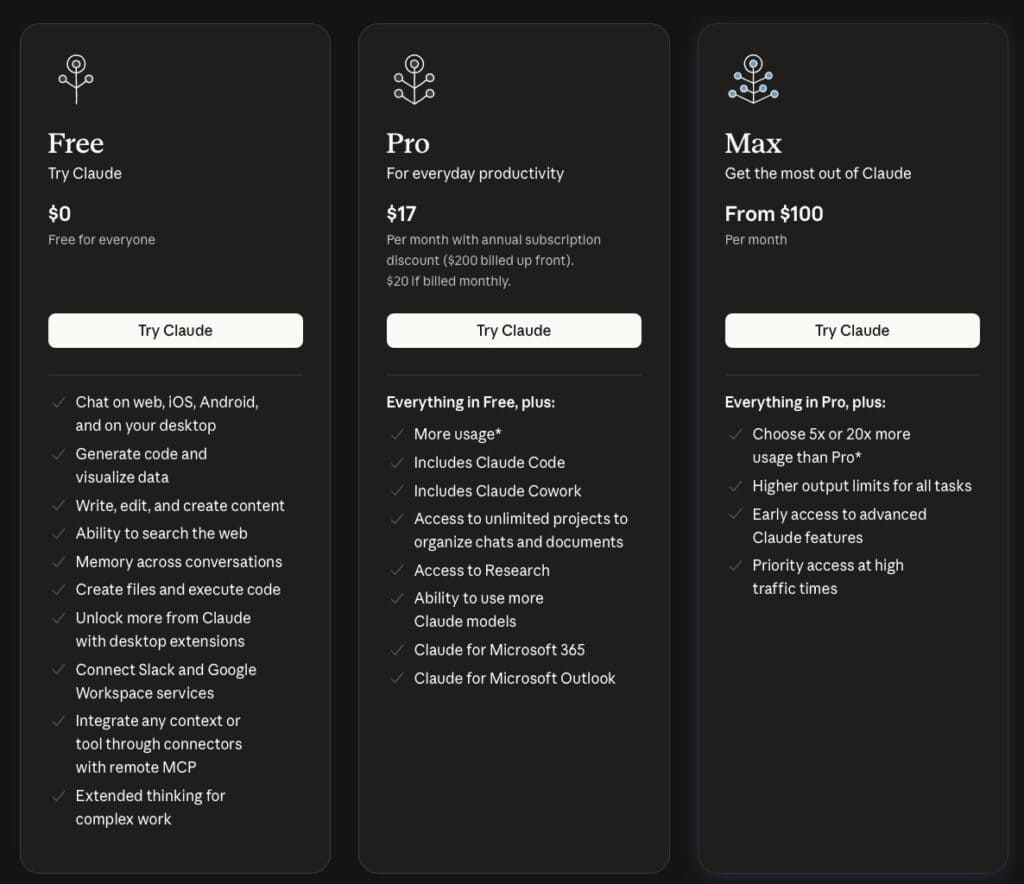
Even if I tend to agree with most of what Alain is stating, I do think that the rise of prices for premium models is predictable. This is due to the gap between investments and business returns. This will almost inevitably lead to an economic divide between the haves and the have-nots. Looking at Anthropic’s Claude pricing structure is indeed revealing in that sense. Beyond the Pro model, which is very limited in token usage, especially if you use the more sophisticated Opus 4.6 model, prices already amount to €1,200 per annum. That is not a negligible sum, which is especially worrying at a time when Claude is rapidly becoming the norm for users who care about quality.
The “AI heroes” problem
One of the most striking formulations to emerge from Alain’s research is what he calls the “AI hero” phenomenon. Across French higher education institutions, there are faculty members doing excellent, innovative instructional work with GenAI, designing new assessment formats, running workshops, rethinking entire modules around AI-augmented learning. They produce results. And they do it largely alone, without institutional recognition, without career incentives, and without any mechanism for sharing what they have learned.
The incentives are wrong. In higher education, research output is rewarded. Course design is not, or at least not in the same way. An “AI hero” who redesigns an entire programme around GenAI competencies may receive less professional recognition than a colleague who publishes a single journal article.
“We need to help all these AI heroes to gain more consideration for educational innovation, which is not necessarily by design the case within higher education.”
The risk, if this is not addressed, is a two-tier system: a minority of digitally confident faculty pulling their students forward, while the majority are left behind, neither trained nor incentivised to engage. The grassroots innovation is real and valuable. Without institutional structures to recognise, reward, and replicate it, it remains an exception rather than a model.
GenAI in Higher Education, Where legitimacy breaks down
The theoretical backbone of the study is Suchman’s triadic model of legitimacy, which distinguishes between pragmatic legitimacy (does the tool serve my interests?), moral legitimacy (does it align with values I hold?), and cognitive legitimacy (is it taken for granted as part of how things work?). The model was built for technologies adopted gradually. GenAI tested it under conditions of near-instantaneous mass adoption, which Alain and his co-authors treat not as a reason to discard the framework but as an opportunity to extend it, introducing a legitimacy-illegitimacy continuum rather than treating it as a simple either/or.
What students reveal
The finding he describes as the most noticeable asymmetry in the dataset concerns the moral dimension among students. Students who are among the heaviest users of GenAI express no moral legitimacy for those tools in academic contexts. They associate them, at high frequency, with cheating, plagiarism, degree devaluation, and unfairness. They are using a tool they consider ethically compromised. This is plainly not sustainable.
However, Alain’s opinion diverges greatly.
“Using GenAI is not necessarily cheating. It depends entirely on how it is used and for what purpose.”
The institutional failure, in his view, is that institutions have not done enough to reframe how the technology is perceived by students.
What faculty reveal
Faculty present a more complete picture. All six dimensions of legitimacy and illegitimacy are present in their responses. Faculty recognise these tools as useful yet question their reliability, consider them professionally necessary while finding their black box architecture suspicious at best, and invoke their inclusive potential even as they flag intellectual laziness and the erosion of critical thinking as their highest-coded concern, at 58 occurrences in the qualitative dataset.
What deans reveal
For deans, the dominant theme is strategic. Competitive pressure, the fear of falling behind, and practical efficiency gains in administrative workflow all generate pragmatic and cognitive legitimacy. What introduces illegitimacy is governance risk: data protection, overconfidence in AI-generated results, and the threat to assessment integrity at institutional scale.
The paper’s most significant theoretical move is the treatment of illegitimacy as an analytic category in its own right, rather than simply the absence of legitimacy. The argument, borrowed from change management theory, is that illegitimacy signals should be read as early warnings requiring proactive response. An institution that treats student moral unease about GenAI as a communication failure misses the signal entirely. That unease is telling something about what its curriculum actually teaches, and what its assessment actually measures.
When students associate GenAI with cheating, unfairness, and degree devaluation, they are not being irrational. They are in the Denial and Resistance phases of the Scott and Jaffe change model. These are illegitimacy signals in Suchman’s sense: early warnings that the technology lacks moral legitimacy. Institutions must act on them, not suppress the signal, but address what it reveals.
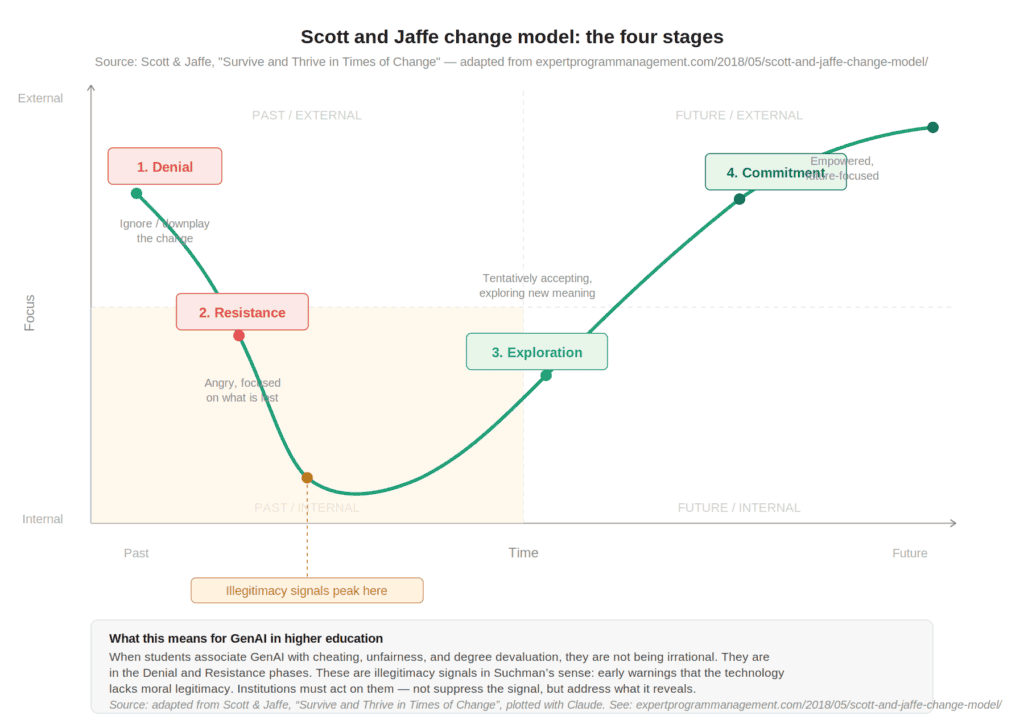
Source: adapted from Scott & Jaffe, “Survive and Thrive in Times of Change”, plotted with Claude. See: expertprogrammanagement.com/2018/05/scott-and-jaffe-change-model/
France, sovereignty, and the global race
The French context adds a layer of complexity that the research captures with statistical precision and qualitative nuance. Quantitatively, the analysis found no statistically significant differences in GenAI adoption patterns between public universities and business schools. Qualitatively, the dynamic differs. Business schools, operating in a highly competitive market, have moved faster. Public universities have engaged more systematically around governance, sovereignty, and collective infrastructure, reflected in the alliance of 35 institutions with Mistral AI and EdTech France.
Alain reads this not as a contradiction but as a division of labour that, if managed well, could represent a genuine asset.
“We need to play collectively, because the competitionMarket definition in B2B and B2C - The very notion of "market" is at the heart of any marketing approach. A market can be defined... is worldwide.”
The sovereign AI infrastructure question, including the ILaaS federation and the French Ministry of Higher Education’s partnership with Mistral rolling out across 26 pilot universities from September 2025, is not merely symbolic. It is an attempt to ensure that French institutions can operate, govern, and adapt their AI tools without dependency on providers whose pricing, terms, and capabilities are subject to change.
This is only sustainable, however, as long as the peer pressure to use this or that tool, based on model performance, is not too strong. At the moment, it is hard to resist the urge to use Anthropic’s Claude when everybody else is praising the quality of its code and results.
The global comparison is difficult to ignore. Singapore, South Korea, and the UAE are embedding AI fluency as a core national competency from secondary education upward. Alain’s view is direct: French public decision-makers are not yet adequately prepared for the scale of what is coming.
“Having less AI-competent people than in other parts of the world is very dangerous for our economy and for all our organisations.”
The regulatory instinct, which runs deep in European policy culture, is not wrong. Taking time to regulate responsibly has value. But it cannot be a substitute for speed of adoption at the level of skills and curriculum.
The question that frames the research
The interview ends, as it probably should, with the meta-question: what does it mean to study the legitimacy of GenAI using GenAI? Alain’s team used ChatGPT, Perplexity, NotebookLM, and OpenAI O3 in the research process, and said so explicitly in the paper’s disclosure statement. His answer to the bias question is careful. Every step of the analysis involved a human coder. Alain’s team checked the AI-assisted coding against a prior independent analysis of the same data, conducted for a French institutional report. The team compared the two rounds.
“You have to be transparent about your use of these tools, for what purpose, at each step.”
The disclosure was a deliberate choice, precisely because the paper’s subject made any other approach untenable.
The line between using AI to improve the quality of writing and using it to generate writing you then present as your own is, technically, a matter of degree. In practice, it is the difference between a craft and an abdication. Alain’s team navigated it carefully enough to publish. Most of the students in his dataset are still trying to locate that line, in an environment where nobody has explained it clearly and assessment instruments have not yet been rebuilt to make it matter.
Three recommendations: one for each stakeholder
When pressed for a concrete policy recommendation per stakeholder group, Alain’s answers were unambiguous.
For students: combine technical AI literacy, understanding how the tools work and knowing their failure modes, with genuine critical and ethical thinking about the outputs they produce. Neither dimension alone is sufficient. A student who can prompt fluently but cannot evaluate the result has learned nothing useful.
For faculty: the “AI heroes” cannot be left to operate alone. Institutions need to create the conditions for sharing best practices across the teaching community, and to give educational innovation the professional recognition it currently lacks. A faculty member redesigning assessment from the ground up deserves at least as much institutional credit as a colleague submitting a conference paper.
For institutional leaders: a multi-level policy framework is not optional. Students, faculty, and administrative staff are not thinking about GenAI from the same vantage point, and a single top-down policy will satisfy none of them adequately. The task of leadership is to hold all three dimensions simultaneously, and to open genuine dialogue between groups before a crisis forces the issue.
“Deans have to think about all these dimensions at the same time, and that’s the hard part of the story around artificial intelligence.”
Of the three, Alain singles out the institutional level as the most urgent. Students and faculty are already adapting, imperfectly, in real time. The institutional frameworks that would give those adaptations coherence and direction are still, in most places, a work in progress.
The urgency is not overstated. Neither is the complexity. The challenge of integrating GenAI in higher education responsibly is one that no institution can afford to ignore, or to solve alone.
Alain Goudey is Professor and Associate Dean for Digital Innovation at Neoma Business School. He is co-author of “Legitimacy and Illegitimacy of Generative Artificial Intelligence in Higher Education: Perceptions from the French Management Context,” published in the Communications of the Association for Information Systems.


