
While the media keep flogging the spectre of AI replacing white-collar workers, a far more discreet factor is quietly undermining the employability of young graduates. The real culprit? Their smartphones. As agentic AI grows in power and the job market reshapes itself every six months, motivation and discipline are becoming more valuable assets than skills themselves. And those are precisely the two things that the major social platforms are working relentlessly to drain away. In this piece, Frederic Cavazza want to push back against the prevailing narrative and face up to something we keep choosing to ignore. Social media, and TikTok in particular, is doing real damage to young people’s motivation, and that has direct consequences for their chances of finding work.
This article was originally published in French by Fred Cavazza on fredcavazza.net. Visionary Marketing translated it and it’s now published on our website with the author’s permission. Throughout the article, “I” represents Frederic Cavazza.
Will AI or TikTok Threaten Young Grads’ Employability?
Key Takeaways from Cavazza’s piece on AI and employability
- The job market is mired in radical uncertainty. The pace of AI innovation makes any prediction beyond two years essentially meaningless, and institutions (government ministries, schools, businesses) are structurally incapable of keeping up.
- Agentic AI will reshape work gradually, not overnight. Intelligent agents will progressively absorb the repetitive tasks previously handled by disengaged employees, leaving little room for middling performers (those who have stopped making an effort).
- Head-on competitionMarket definition in B2B and B2C - The very notion of "market" is at the heart of any marketing approach. A market can be defined... with AI must be avoided. Rather than trying to rival AI on raw processing power or rote memorisation, the priority is to develop the forms of intelligence that machines cannot master (interpersonal, intrapersonal, existential, and so on).
- TikTok is the real killer of young people’s employability. Social media consumes their time and energy (the two fuels of motivation), degrades their attention, and produces an army of apathetic NPCs.
- The solution is individual, not collective. Neither legislators, nor educational institutions, nor businesses will be able to keep pace with Big Tech, so it falls to each of us to develop our own “agency” (autonomy, discipline, capacity to learn) in order to justify our employment and our salaries in a world of AI.
As it happens at the end of every quarter, US-listed companies publish their interim results. And as has been the case for several years now, the quarterly figures from the major tech firms confirm ever-increasing investment in infrastructure: Google, Microsoft, Meta, and Amazon capex spending to hit $725 billion in 2026, up 77% from last year.

Do these hundreds of billions of dollars being poured into data centres reflect genuine demand? On the face of it, yes, though not entirely. The honest answer is that it depends very much on who you ask and how you frame the question.
Build It, and They Will Come (Eventually)
According to the official statements from startups, AI publishers, and Big Tech, demand currently far outstrips supply. That is not necessarily cause for celebration, however, because it is worth remembering that this so-called AI demand (meaning what users actually consume) is heavily subsidised. At present, the business models simply do not stack up (subscriptions are sold at a loss: AI Is Too Expensive To Ever Pay Off Hyperscalers’ Capex Investments).
It comes as no surprise, then, that after a period of explosive growth driven by extremely aggressive customer acquisition, the maker of Claude has quietly revised its pricing in an attempt to limit the damage: Anthropic Just Quietly Raised Claude Pro Bill.
Assessing genuine demand is therefore extremely difficult, since it is being artificially propped up by startups burning through other people’s money with reckless abandon to acquire new users. What is certain, though, is that this phase of hypergrowth is generating a knock-on surge in demand for skilled workers.
We can already observe an explosion in demand for generative and agentic AI skills, as evidenced by the findings of the Malt Tech Trends 2026 report: From AI agent demand (×60) to the growth of n8n projects (+1,390%): welcome to the operationalisation era.

Fair enough, you didn’t need me to tell you that, but now that we have precise statistics to quantify demand, we may as well use them. Also worth reading: Agents, robots, and us: How AI reshapes work and skills in Europe.

From this, one might assume that all it would take is a shift in training to ensure that new graduates acquire the skills businesses actually need. That is the theory, at any rate. In practice, what is taught in higher education is dictated by the certification frameworks set by the relevant government ministries. Those ministries, however, move to a completely different rhythm from the business world. Updating a skills framework can take several years, yet the job market is being reshaped by AI innovation every six months.
To put it simply, students are trapped in a system that is setting them up to fail: “I feel I missed my moment by just one year”: how AI is holding back junior hiring. Given the helplessness of institutions and teaching staff alike, student anxiety is palpable: GenAI in Higher Education, Legitimacy and Laziness. Little wonder, then, that the figures coming out of various studies are provoking real anger:
- -14% in employment entry rates for 22-25 year-olds in AI-exposed roles (Anthropic study);
- -20% in jobs for young developers since the end of 2022 (Stanford study).
Which skills should young people be developing to protect their employability? That is genuinely difficult to say, given the current instability of the market (pace of innovation, geopolitical tensions, scarcity of raw materials). In this era of polycrisis, the only viable stance is one of caution, holding off on major decisions and delaying hiring.
The problem is that hundreds of thousands of young graduates flood the job market every year. And I haven’t even touched on the equally fraught situation for those looking for internships or work-study placements. All of which explains why AI is such a raw nerve for young people (Gen Z Is Using AI, but Doesn’t Feel Great About It), to the point of causing outright hostility:
- Ex-Google CEO Eric Schmidt Fails to Read Room on AI, Gets Booed into Oblivion
- UCF commencement speaker met with boos over pro-AI remarks during ceremony
- Big Machine CEO Scott Borchetta fires back at graduates booing ‘AI speech’ during Middle Tennessee State University ceremony
Confronted with the doom-laden scenarios served up by the media, a significant proportion of young people simply want nothing to do with AI. Worth noting, too, is that attitudes towards AI track closely with how well people understand it. Simply put, the more you know, the less you fear.

That said, understanding AI has been made considerably harder by a pace of innovation I have never encountered in thirty years. This relentless tempo is feeding a widespread sense of uncertainty that is paralysing businesses and disrupting recruitment. Whilst everyone agrees that major changes are on the way (AI: the coming upheaval in the labour market), nobody can agree on what those changes will actually look like, or when they will arrive.
Anyone who cares to look will find that the research remains as contradictory as ever:
- The “AI Job Apocalypse” Is a Complete Fantasy (= mass replacement simply isn’t happening);
- US Is Starting to See Heavy Job Losses in Roles Exposed to AI (= layoffs and hiring freezes are becoming increasingly significant).

This creates a great deal of confusion, and inevitably leads to sharply divergent views:
- AI agents aren’t replacing software engineering but expanding it far beyond code, researchers argue (= AI won’t replace developers);
- CEOs and Boards Are Aligned on AI in Theory, but Divided in Practice (= shareholders want to push ahead with AI while executives remain more cautious).

At this point, it seems clear that a truth nobody wants to say or hear is beginning to surface. We simply do not know.
We Don’t Know Where We’re Going, But We’re Going There Anyway
As I mentioned earlier, the pace of innovation is so high that it is practically impossible to predict more than two years ahead, let alone anticipate how the market will evolve over six months.
What is certain, though, is that as models and tools are making headway, AI systems are accumulating ever greater knowledge and capabilities, reaching into areas nobody would have thought possible six months ago (Anthropic expands legal AI offerings with new Claude Cowork plugins).
Faced with this relentless race, how should you prepare for the wave of generative and agentic AI? Quite simply by avoiding direct competition. It is fairly obvious that there is no point trying to match AI on its own terms, in areas like raw computation or rote.
Stating that white-collar workers genuinely need to differentiate themselves from AI, and that doing so means drawing on skills and forms of intelligence that machines cannot master is merely spelling the obvious.
As a reminder, there are many forms of intelligence, eleven types to be precise, as defined by the Theory of Multiple Intelligences.

Whilst AI excels across several forms of intelligence (linguistic, logico-mathematical, musical, spatial), humans retain the advantage in those more abstract forms that machines struggle to replicate, namely interpersonal, intrapersonal, and existential intelligence. Those are the forms worth cultivating. Memorisation and basic logic? The basics are quite sufficient.
AI, Non-player characters and Employability
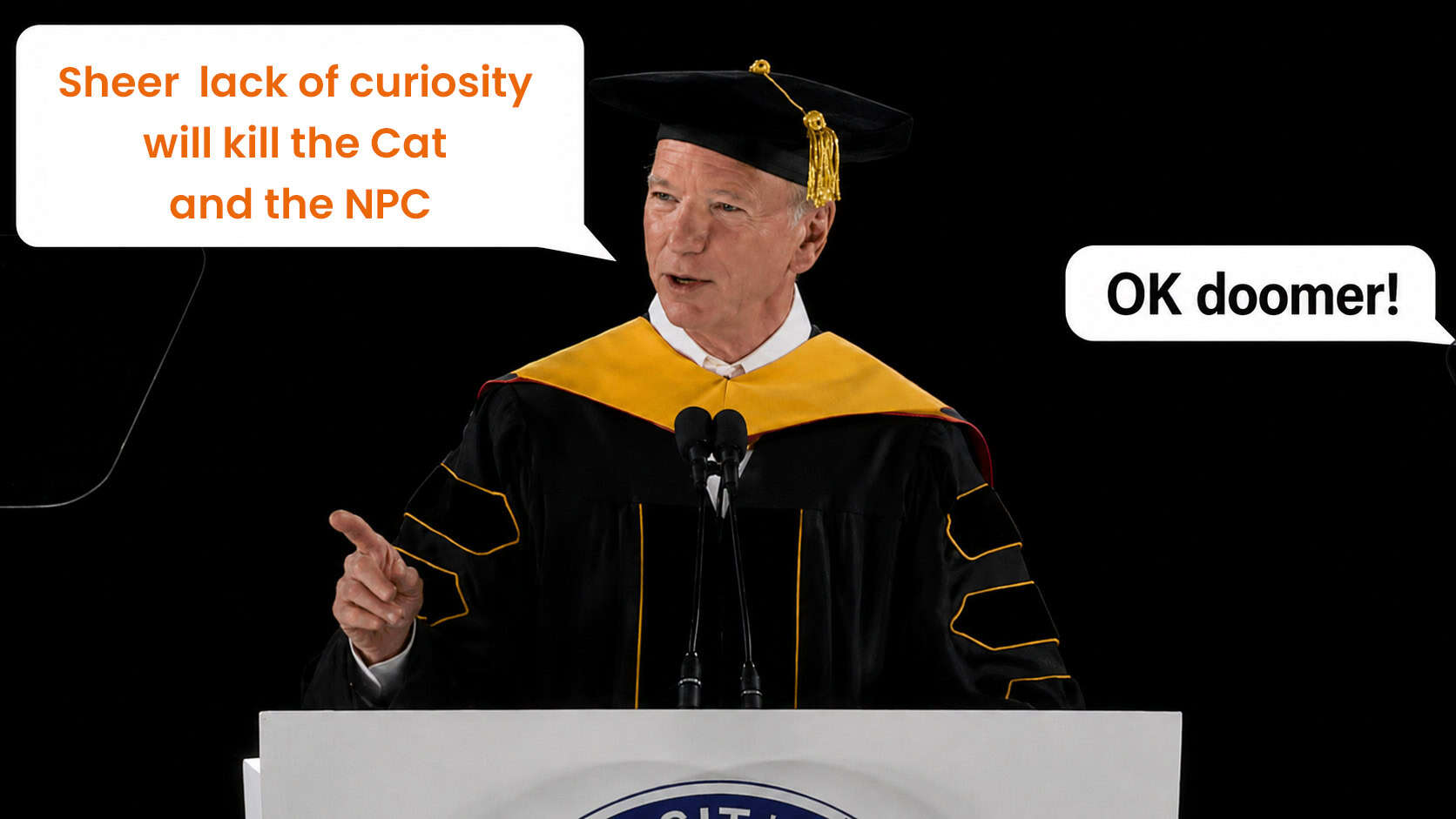
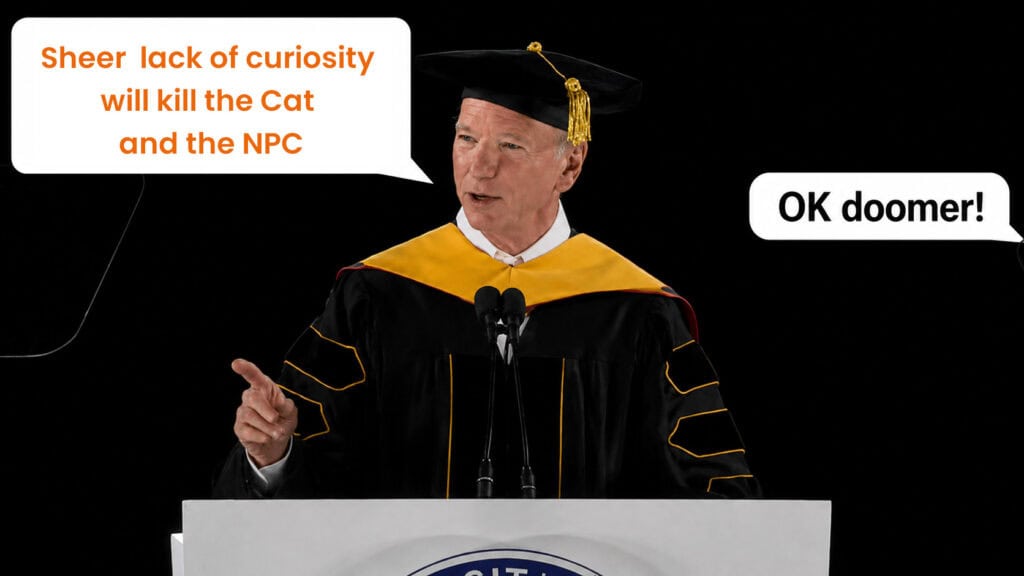
Which brings us to this. If you have no curiosity and no drive to develop new skills, you are an NPC (non-player character), one of those video game figures with whom basic interactions are possible but who, broadly speaking, serve no purpose beyond filling space.

You are most certainly familiar with The Sims, the Electronic Arts video game series presented as a life simulation.
A humorous, offbeat take on consumer society, in which there is no specific objective. The player simply manages the needs of their characters, known as “Sims”, and steers them towards the life they want them to lead.
The Sims and NPCs
In the game, the Sims are the non-player characters who go about their daily lives without ever questioning anything, in a state of total blissful indifference. If they are not living the life they want, they express their dissatisfaction with a little black cloud above their heads, but they will never rebel, because they have no real say in their own fate.
I know this will not win me many friends, but I sometimes feel as though I am living inside The Sims. Whether in the companies where I carry out consulting work, or in the Master’s seminars I have been teaching for years at various institutions, I am broadly confronted with an army of Sims, NPCs who ask very few questions, and who expect their employer, their school, or their government to look after them and find solutions to improve their daily lives (training, redeployment, subsidies, financial support, and so on).

Do not misunderstand me. All these passive employees, students, and citizens were not born that way. They became that way through spending their time on social media, watching other people live rather than living themselves, moaning about not owning this or that status symbol rather than working hard to afford it.
Social media nonsense

Social networks were supposed to bring us closer together, but twenty years on, the inescapable conclusion is that social media has gradually eroded the motivation and ambitions of billions of users, keeping them in a state of passivity and dependency. It is the content feed that tells them what to buy, what to eat, what to watch or listen to, where to go on holiday, who to vote for.
The purest expression of this social-media lobotomy can be found in the trends and memes that flood our feeds and supply micro-doses of dopamine to billions of users now addicted to their phones (Forget the A.I. Apocalypse, Memes Have Already Nuked Our Culture).
Apathy vs A Critical Moment in Human History
I know, the assessment is harsh and the criticism blunt. But I believe it is both justified and necessary. The apathy produced by excessive social media use, and TikTok in particular, is incompatible with the critical moment humanity is now going through (permanent crisis, resource scarcity, geopolitical tensions). Simply put, daydreaming shouldn’t be on the agenda.
At a time when young people should be throwing themselves into the challenges of the 21st century and working twice as hard to protect their employability in the age of AI, they are instead being distracted by Clavicular hammering himself in the face to look more masculine (Handsome at Any Cost).

This new idol of youth has hundreds of thousands of followers on TikTok and tens of millions of views on Kick, the live streaming platform on which we witnessed the death of Jean Pormanove last summer (Can’t get a girlfriend? Smash your face with a hammer).
Since I am no sociologist, I will refrain from analysising looksmaxing or the manosphere. But I do have a front-row seat for the growing gap between those whose willpower and ambition are being sapped by influencer antics on TikTok and those who are fighting to take control of their futures. That gap is all the more worrying given that young people’s employability is plummeting as AI performance rises.
There is a growing gap between those whose willpower and ambition are being sapped by influencer antics on TikTok and those who are fighting to take control of their futures. It is all the more worrying given that young people’s employability is plummeting as AI performance rises.
This battle against brainrot isn’t lost
Contrary to what doomers would have you believe, this is not a lost cause. And despite what populists may promise, universal basic income or taxing the rich is not a viable response to the rise of AI.
Humanity will be saved when individuals have honed their ability to adapt and meet new challenges. But that requires a basic minimum of willpower and, above all, genuine engagement in an increasingly competitive professional environment.
Engagement Over Skills
Some argue that studying is no longer necessary, since AI will soon provide all the knowledge and skills anyone could need. I do not subscribe to this view, as it rests on a deeply reductive understanding of what education is for.
Education should not be seen merely as a phase of knowledge acquisition (that knowledge will be obsolete within a few years anyway), but rather as a transitional period that allows young people to better understand how society and the professional world actually work, with all their rituals, pretences, and dysfunctions.
Preparing for the future with Education
Education offers a chance to prepare for the future by observing and understanding both the explicit and implicit rules of the game. It also fosters learning how to learn, developing autonomy and resilience. Admittedly, student life can be challenging, especially with the intensive workload and high expectations, particularly for those on work-study programmes. However, it remains the only true path to cultivating the discipline needed for employability, especially in today’s context of rising agentic AI.
AI agents will outperform average employees for repetitive tasks
For repetitive and predictable tasks, which dominate most office jobs, AI agents will consistently outperform the average employee. This is particularly true in Europe where labour costs are high. We’re gradually moving towards a future where disengaged employees – those who don’t ask questions, seek improvements or challenge the status quo – will be replaced by AI agents overseen by a small team of dedicated and motivated staff. For example, in two Amazon units “builder” has replaced traditional job titles.
This reading suggests no sudden wave of job destruction but rather a gradual shift in business operations. AI will reshape more jobs than it replaces. Unfortunately, this reconfiguration will leave little room for “average” employees like the NPCs described. In this context, what truly matters isn’t your current knowledge or skills (which are quickly devalued) but your motivation drive for improvement and commitment to learning new things. You needn’t worry too much about raw capability (task performance) as AI agents will handle that.
Ultimately, this all comes back to a motivation problem, one that affects young people above all. Meet “Idle Generation”, a generation corrupted by the distorting mirror of social media.
No Motivation Means No Engagement
If we accept that motivation depends on time and energy, it becomes immediately clear that social media is a motivation killer, draining both of these precious resources. That is why I am convinced that the main obstacle to young graduates finding work is not AI, but TikTok!
I am convinced that the main obstacle to young graduates finding work is not AI, but TikTok!
That said, I am not exactly going out on a limb here, since many have sounded the alarm before me, and the statistics consistently point in the same direction:
- Teens’ Experiences on TikTok, Instagram and Snapchat
- Why teens with ADHD are so vulnerable to the perils of social media
- Online platform audience observatory (France’s Regulatory Body Arcom) [mostly in French]
In the UK, France and Germany, social media reaches over 79% of the total population on a monthly basis, with penetration rates of 81%, 79% and 79% respectively (source: DataReportal / We Are Social, April 2026). However, one factor complicates the picture. “Filling spare time” is the second most cited motivation for using social media, for nearly 40% of users globally, according to GWI data published by DataReportal. This is the antithesis of joyful browsing. It involves doomscrolling social media feeds and compulsively filling an attentional void with an endless stream of content.
Dominant platforms have prioritised entertainment over the other four key criteria: staying in touch, catching up on news, sharing passions and following friends. This shift is driven by the ease of monetisation, a cleaner product proposition and simpler optimisation. Essentially, social platforms have become overly focused on content and less on nurturing the weak ties that truly motivate people. Content comes before connection and entertainment before relationship.
Excessive social media use especially TikTok negatively impacts young people’s mental health, already vulnerable. Furthermore it severely hampers their employability by shortening attention spans and reducing concentration.
The steady decline of published content, particularly on social media, has further fuelled this phenomenon. The rise of short-form video and micro-clips has led to your feed being overrun with clips, all thanks to the cutthroat community of “clippers” behind them. The resurrection of Vine, backed by Jack Dorsey, is unlikely to improve matters.
You might think I am overdoing it, but sociologists and linguists are unequivocal. The rise of social media and the proliferation of visual content have led to a decline in interpersonal communication: We’re All Talking to Each Other Less Than We Did a Decade Ago. Believe it or not, the volume of words exchanged with other human beings has fallen by 28% in less than fifteen years.
Have we hit rock bottom? I would like to think so.
AI and Employability: Less Time on TikTok Is Still Too Much Time
You might take comfort in pointing to the slowdown in social media growth: Have we passed peak social media?

A Decline in Meta’s Global Audience
All the more so since, for the first time in its history, Meta is reporting a decline in its global audience: Meta stock drops on quarterly results as ‘internet disruptions’ in Iran drag down user numbers.
On top of that, some studies suggest that younger users are turning away from social media (Gen Z leads drive away from social media) and even from their smartphones altogether, with a resurgence of interest in dumb phones (Dumb phones are making a comeback). It’s certainly a heartening narrative, but it feels more like a passing fad than a genuine shift. The trend of reissuing the Nokia 3310 is fashionable, but it doesn’t indicate a widespread change. A simple walk outside or a glance at office, school and university environments confirms that young people are still as fixated on their phones as ever.
The problem is that the “young people” we’re talking about are legally adults and therefore fully entitled to squander their futures by wasting time on TikTok while blaming AI. It’s a perfect red herring.

That’s precisely why solutions are so difficult to enforce; you can’t simply force them down people’s throats.
Defending Youth Employability, and Much More!
In Europe, where most of us live in democracies, public opinion theoretically holds sway over legislators. This could result in pressure to ban social media for younger users or prevent companies from conducting layoffs, as is currently the case in China. For instance, a Chinese court has even banned companies from firing workers solely due to AI replacement.
Let me remind you, though, that social media age restrictions for minors have been stalled for months (European Parliament backs 16+ age rule for social media), whilst it took nearly five years to crack down on the nitrous oxide craze despite numerous deaths: French Senate bans the sale of nitrous oxide to the public [Fr]. How long do you think the European Parliament will need to meaningfully legislate on AI? Five or ten years? By then it’ll be too late as Big Tech will have developed superintelligence. Here’s why Google DeepMind’s CEO believes the singularity is closer than ever.

AI Innovation: Beyond Control
The rapid pace of AI innovation far exceeds the capacity of businesses and institutions such as educational establishments and governments to develop enforceable and sustainable solutions.
I firmly believe the solution to the declining employability of young graduates lies in personal responsibility rather than collective action. It’s up to each of us to seize control of our futures. To thrive in a world dominated by AI agents, we must cultivate our own “agency”. This involves developing our capacity for action (autonomy) and learning (as discussed in In Defence of Thinking). Furthermore, motivation and discipline are essential for justifying employment and salary, and these qualities cannot be found in mindless scrolling through TikTok.
The article’s main premise is employability and its underlying reasons are lack of motivation and discipline, disengagement, all stemming from smartphone and TikTok addiction. My sole ambition was to raise awareness about this. Despite numerous warnings, the problem persists because no one can halt or even slow AI’s progress. Its impact will transcend technology and economics becoming fundamentally social and potentially even civilisational.
Should we pray for improvements like reduced social media use and the control of AI? I’m sceptical but my opinion doesn’t matter much. Perhaps you should refer to Pope Leo XIV’s first AI encyclical with Anthropic’s co-founder as a guest speaker.
Q&A about AI and Employability
Why consider TikTok a bigger obstacle to employment than AI itself?
Motivation hinges on two crucial resources: time and energy. Social media and especially TikTok consume these in enormous amounts. Consequently, smartphone and TikTok addiction shortens young people’s attention spans and concentration, directly impacting their employability in a job market undergoing a seismic shift due to AI.
Will AI cause a sudden and massive wave of job destruction?
I don’t believe that’s the case. More likely, businesses will undergo a gradual reconfiguration of their operations. Predictable and repetitive tasks will be delegated to AI agents, overseen by a small team of dedicated employees. Those with low engagement will be the first to face uncertainty.
Which skills should young people focus on to protect their employability?
Competing with AI in terms of processing power or memorisation is futile since those battles are already lost. Instead, the focus should be on developing forms of intelligence that are more difficult to automate like interpersonal, intrapersonal and existential intelligence. Additionally, qualities such as motivation curiosity and a commitment to learning and developing new skills are important.
What does the concept of an “NPC” mean in a workplace or educational context?
The term originates from video games and non-player characters. In this article, it describes passive employees or students who don’t ask questions and simply wait for their employer school or the state to provide solutions. These are the very profiles AI agents will first replace.
In this situation, can we expect a response from the public authorities?
I don’t think so. Institutions and legislators operate on a timescale incompatible with the rapid pace of AI innovation, which constantly reshapes the market every six months. Therefore, the solution lies primarily in personal development, cultivating your own “agency” – your capacity to act learn and think independently.