
If you ever needed a reason to attend Vivatech 2026, here it is: hard evidence that marketing and communications departments are being transformed from top to bottom. Can a marketing or communications director get anything useful out of a tech show? The answer is a resounding yes, and perhaps more so this year than ever before, as AI is reshaping the marketing function in fundamental ways. The CMO Summit was built for them, and AI will take centre stage.
AI and the forced reinvention of marketing departments
If you are following the rapid, AI-driven overhaul of marketing leadership, here are a few sessions you cannot afford to miss at the Vivatech 2026 CMO Summit:
- 6 months to become an AI-native CMO, or become irrelevant
- The CMO on a hot seat: aligning strategy, business and leadership for impact
- How CMO lead in an AI-first world?
These session titles from this year’s Vivatech CMO Summit give a good sense of what is at stake, with a palpable sense of urgency thrown in for good measure.
As AI accelerates, the marketing role is changing fast and fundamentally. The technology’s use cases no longer stop at creative optimisation or large-scale data analysis. They now touch every dimension of traditional marketing.
Half of all marketing tasks automated by AI within three years?
To grasp the scale of the shift under way, the 2026 “Trends of AI” study published by Les EnthousIAstes and KPMG France offers a useful snapshot. Conducted among more than 350 senior executives, it maps AI adoption across the eight core functions of a business. On marketing specifically, respondents estimate that at least half of all marketing activities will be automated by AI within three years. As Quentin Briard, Chief Marketing, Digital, Data and Technology Officer at Club Med, puts it in the study: “AI represents a break of unprecedented scale.”
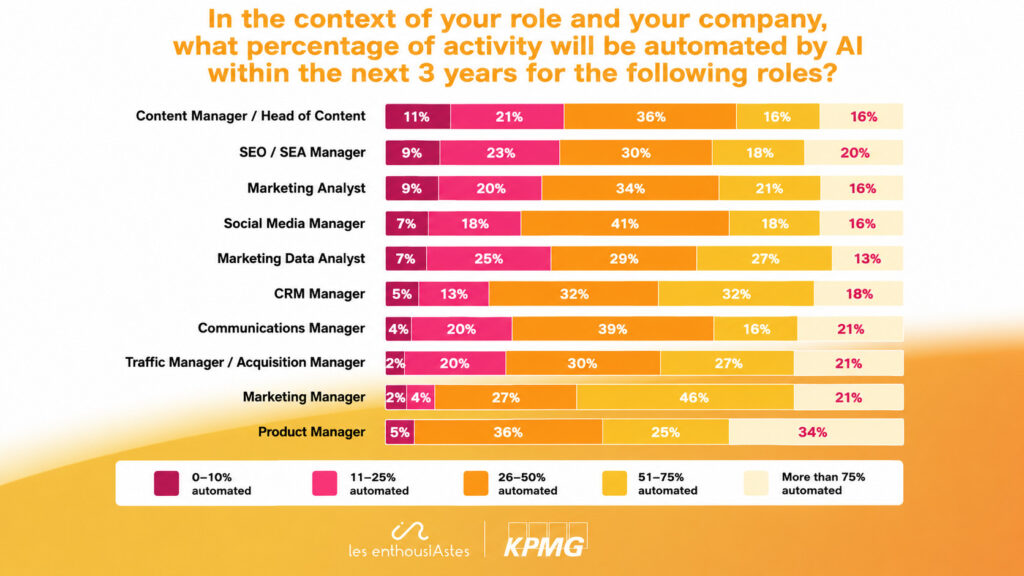
François-Xavier Leroux, Partner and Head of Business Consulting at KPMG France, and Benoit Girard, Marketing and AI Director at KPMG France, highlight that « content-oriented and digital roles appear to be the most vulnerable. Nearly half of respondents believe between 20 and 60% of tasks in these roles will be automated while 10% think it could be over 60%. »
Among the examples cited in the study, L’Oréal (with its internal L’OréalGPT platform for chat and AI agents), the RATP (the Paris public transport authority, with Tootie, its first AI-powered conversational tourist guide) and Verisure (a personalised recommendation engine across all customer touchpoints) begin to sketch out what is now within reach.
Cracking the AI scaling problem in marketing
The “Trends of AI” study also makes clear that, right now, very few French companies have successfully moved beyond pilot projects to full-scale AI deployment. This is precisely one of the central questions at Vivatech this year. Under the banner “Impact, Not Illusion,” the show sets out to demonstrate how AI can move from exploration to industrialisation, with a clear and measurable return on investment.
Almost every company surveyed by Les EnthousIAstes and KPMG France has launched something in AI, yet adoption remains largely confined to experimentation. In 78% of cases, organisations simply make tools available for staff to use as they see fit. And 55% of respondents admit to operating in proof-of-concept mode, with no plans to scale up at this stage. Only 18% say they have a clear roadmap, backed by a structured and monitored action plan aimed at full deployment.
180,000 visitors expected, including 10,000 marketing decision-makers
With an extensive conference programme spanning more than 450 speakers, Vivatech promises to address the full range of questions marketing leaders grapple with every day, and in doing so help them build their data and AI roadmap. The CMO Summit, the centrepiece of the marketing conversation, takes place on Friday morning in Hall 7.2. It will be opened by Maurice Lévy and will feature contributions from Asmita Dubey, Chief Digital and Marketing Officer of the L’Oréal Group, Bonnie Pelosi, CMO EMEA at Microsoft, Julie Touyarot, VP Growth and Marketing at Doctolib, and Rachel Thornton, Chief Marketing Officer at Adobe.
Of the 180,000 visitors targeted for this tenth edition of the Paris show, no fewer than 10,000 CMOs, marketing decision-makers and experts are expected. A dedicated space, the CMO Lounge, has been set aside for them. But as is so often the case, the most valuable conversations will happen informally, in the aisles. With upwards of 4,000 exhibitors and 15,000 startups spread across 70,000 sq m (20,000 sq m more than last year), marketing leaders will also have ample opportunity to identify solutions for their specific challenges. Whether to go is, frankly, not really a question.