
After years spent on producing creative content the hard way, here comes the AI Creative Studio, to boost innovation and creativity. Some creatives and marketers are impressed, some not. So, what will it come to eventually? Visionary Marketing attended a conference on the subject at Vivatech 2026 in Paris and here is our analysis.
The AI Creative Studio Comes of Age at VivaTech 2026… With a Few Provisos
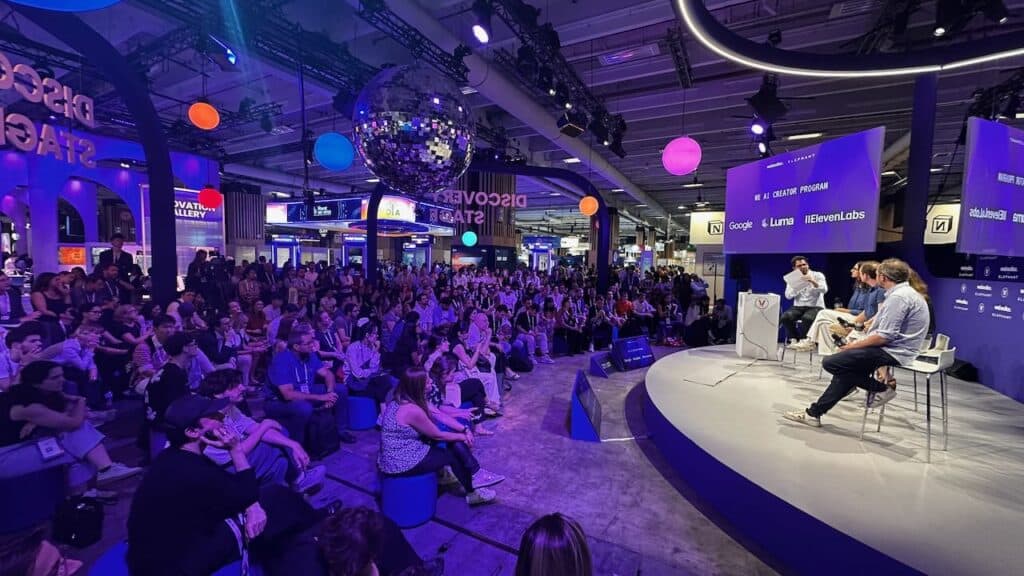
VivaTech celebrated its tenth anniversary this June at the Porte de Versailles in Paris, and the contrast with the first edition is striking. What began in 2016 as a 45,000-person gathering has become Europe’s largest technology event, drawing more than 180,000 visitors from over 170 countries. I covered it for Orange Business years back; what it is today bears no resemblance to what it was then.
High Tech: not so toxic after all
Despite the prevailing narrative in parts of the media that high tech has become toxic, a mixture of political backlash and cultural scepticism, the crowd at Porte de Versailles tells a different story. VivaTech is B2B, it is massive, and for those who still assume B2B is small and B2C is big, the sheer number of startups alone, 15,000 this year, is sufficient proof to the contrary. Among the sessions I attended, one in particular captured something I have been watching take shape for months: the emergence of a new kind of AI creative studio, no longer a side experiment but a structured industrial bet on the future of content.
TL;DR – Key takeaways from this article
- VivaTech 2026 drew 180,000+ visitors: the anti-tech backlash narrative does not hold
- Webedia-Elephant launched “Human After All”, a physical AI creative studio in Levallois, backed by Google, Luma AI and ElevenLabs
- The demos were impressive; the production pipelines behind them were not shown
- OpenAI Sora collapsed under $15M/day compute costs: the market has already weeded out the weakest players
- AI accelerates in the direction you were already heading; it does not change direction
- The digital divide is real: professional AI voice and video tools cost $22–$99/month per platform
- Three questions remain open: ethics and rights, access equity, and the gap between demo and production
A partnership, a studio and a name that says it all
The session was organised by Webedia-Elephant, a French media, technology and entertainment company reaching 380 million people monthly across social platforms, media brands and creator ecosystems, operating across 15 countries through more than 60 brands since its founding. At the end of May 2026, Webedia-Elephant announced a major expansion of its partnership with Google Cloud and YouTube, structured around three pillars: data modernisation via BigQuery, agentic AI deployment for employee productivity, and the launch of a physical AI creative studio called “Human After All.” The name is deliberate. As Pauline Butor, Director of Creative and Development at Webedia-Elephant, explained on stage, what audiences want most right now is authenticity, which is by nature human. The technology without a vision behind it is just noise. That is the founding conviction of the whole initiative, and it is hard to argue with.
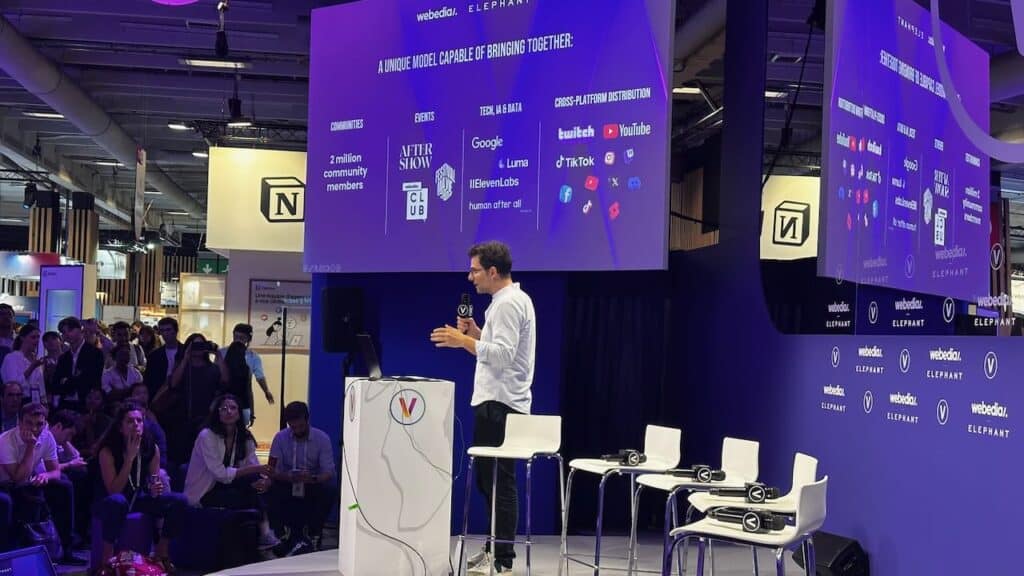
I find the name entirely coherent with the stated ambition. The real question I walked away with is a different one: is this a genuine creative proposition, or is Webedia placing itself as an intermediary between the technology and the people who need it, effectively re-intermediating something that was in the process of being disintermediated? The need for a bridging role is real. The knowledge gap is real. But so is the risk that, as marketers gain fluency with these tools, they will eventually bypass the agency layer altogether.
Three pillars and a select cohort of fifteen
Human After All is built on three elements. The first is a curated suite of generative AI and agentic tools selected for creative professionals. The second is a physical studio space in Levallois, north-west of Paris. The third is the Creator Program, a three-month acceleration and experimentation framework for a select cohort of fifteen participants, drawn from content creators, producers, brands and Webedia’s own internal teams. The programme mixes workshops with office hours, one-to-one conversations for creators working on specific projects, and is designed not just to teach a specific tool but to help participants master innovation in a way that is relevant to each individual.
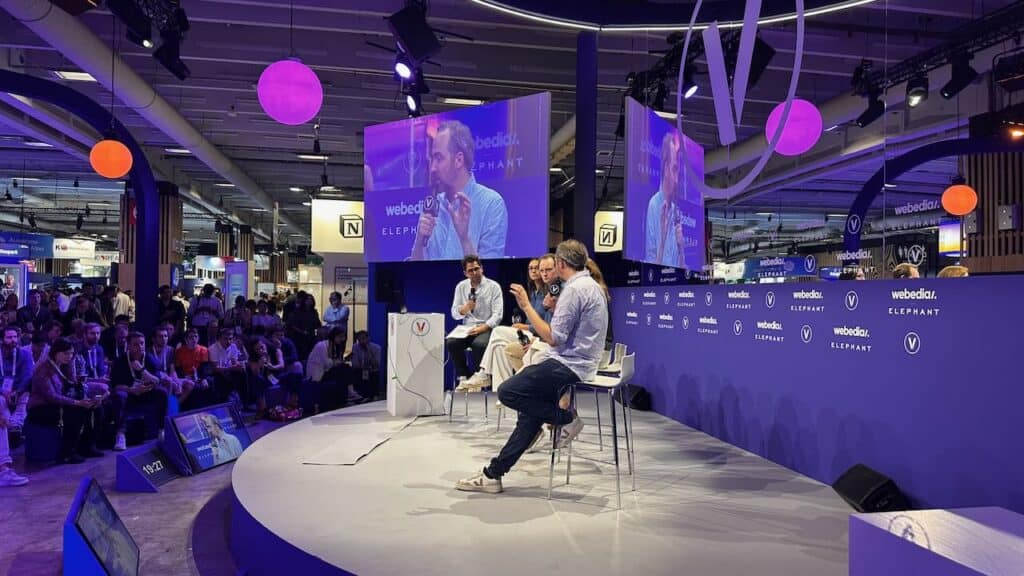
The technology partners assembled for this initiative are not minor players. Matthieu Blanc, AI Specialist at Google Cloud, described how Google’s contribution extends beyond tooling: alongside the Gemini Enterprise deployment, Google Cloud will run a dedicated acculturation programme across all Webedia-Elephant functions. Jason Day, Head of EMEA at Luma AI, brought Dream Machine to the table. Launched in February 2026, the platform is built on Ray 3, Luma’s third-generation reasoning video model, which introduced native HDR generation, physically accurate rendering and video-to-video capability that places actors in entirely new environments without a green screen. Lenaig Guilleux, GTM Director France at ElevenLabs, completed the audio layer: ElevenLabs covers the full spectrum, from text-to-speech and speech-to-speech to voice dubbing that preserves vocal identity, custom music and sound effects generation, and full-stack agentic solutions capable of automating real-time voice interactions.
What the demos actually showed
The live demonstrations were genuinely striking. The Luma AI sequence showed two Webedia-Elephant colleagues, shot in a Parisian café two weeks earlier, transported into a completely different visual context: changed costumes, changed setting, changed props. The coffee cup on the table became a whiskey glass, all without a green screen, in a workflow assembled roughly thirty minutes before going on stage. The ElevenLabs demo showed Lenaig Guilleux’s own voice translated into another language while retaining her accent and intonation. Guillaume Payan, Head of AI Transformation at Webedia-Elephant, drew out what this means for a group operating in France, Brazil, Mexico, Germany and Spain: an entirely new production horizon for creators who do not work in English.
The full production pipeline conundrum
That said, nobody showed the full production pipeline. Nobody explained how long the café sequence took to assemble from raw footage to final output, or how many iterations were needed. This is a recurring pattern in AI creative demonstrations, and it matters. The precedent that comes to mind is Joanna Stern and Jarrard Cole’s all-AI short film for the Wall Street Journal, which assembled roughly 1,000 AI-generated clips across multiple tools and a considerable amount of trial and error to produce a three-minute piece. The final product looked seamless. The process behind it was anything but. The gap between what an AI creative studio demo reveals and what the production reality requires is, for now, significant.
It is also worth noting that the marketMarket definition in B2B and B2C - The very notion of "market" is at the heart of any marketing approach. A market can be defined... itself has not been kind to every entrant. OpenAI’s Sora, the text-to-video model that dominated headlines through 2024 and 2025, was shut down in March 2026 after burning through an estimated $15 million per day in compute costs against $2.1 million in total lifetime revenue. A potential $1 billion partnership with Disney never reached a formal agreement. The survivors, Runway, Luma AI, Kling and Google Veo, are those that built sustainable unit economics around genuinely useful workflows, not spectacle. The category has matured fast and weeded out faster.
An enabler, yes. But of what, exactly?
The panel’s consensus converged on a single position: AI is an enabler, not a replacement. Every speaker reinforced it. Pauline Butor described the technology as having changed the time to test and the time to market completely. This is allowing creatives to validate ideas immediately. Jason Day argued that anyone, a creative director, a film director, a student, now has access to tools that can take the seed of an idea somewhere real. Matthieu Blanc pointed to entirely new mediums and new forms of content as the horizon he finds most exciting.
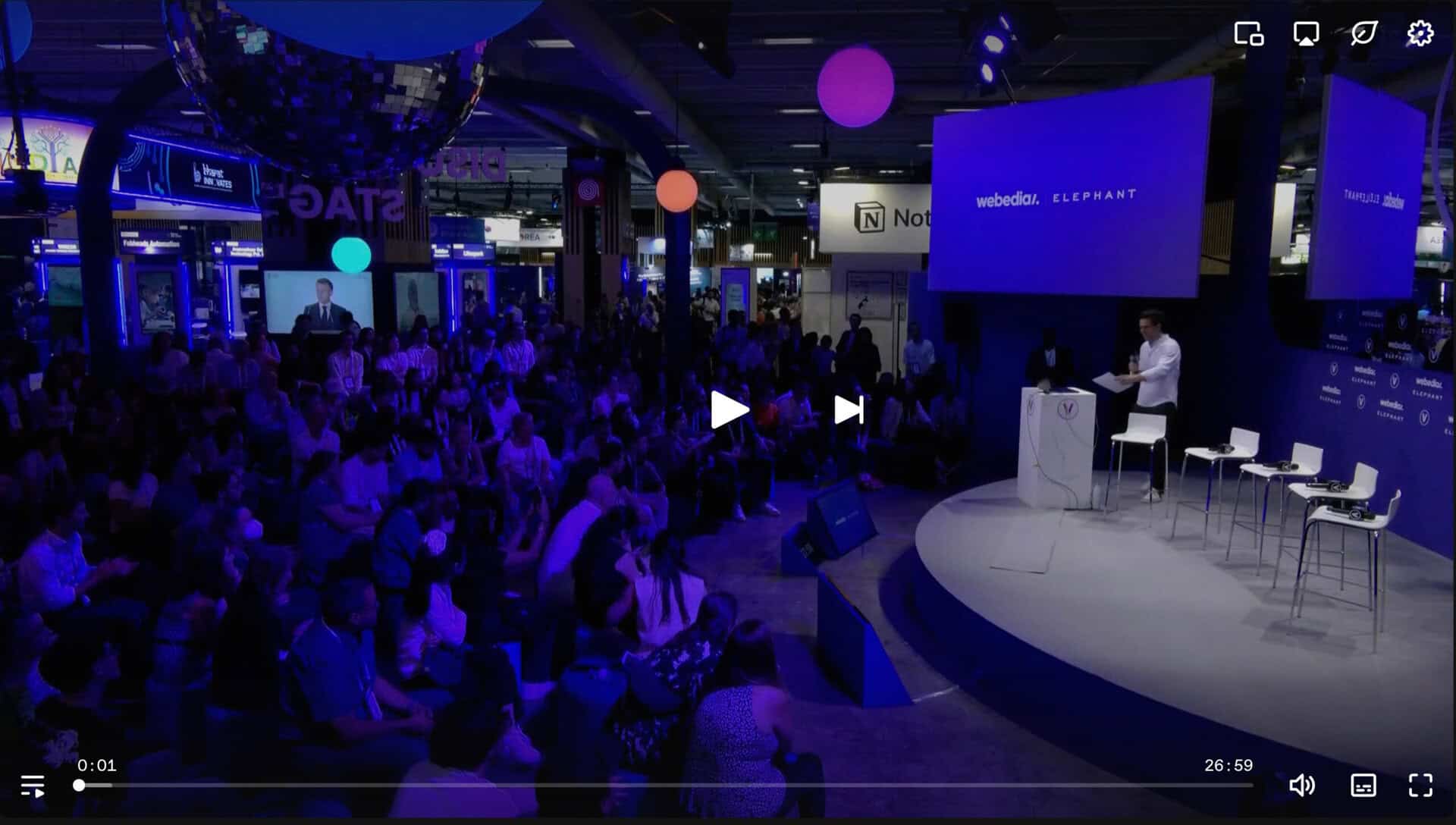
Replay of the AI Creative Studio event
I agree with this reading, and I have seen it bear out in practice. Creative people with AI become more creative. People with good taste produce more and better work. The corollary, which nobody on stage mentioned, is equally true: people with bad taste produce more and worse work, and those who are not curious will not become more curious through AI. The technology is an accelerator, but it accelerates in the direction you were already moving.
Where I am less convinced is on the question of value distribution. The analogy I keep returning to is digital photography. When affordable digital cameras arrived, they were genuinely democratising: more people could take photographs, and some were extraordinary. But the economics of photography were permanently altered. The street photographers, the mid-tier studio professionals, the specialists who were not the likes of Martin Parr exited the market. A handful of analogue practitioners still command significant prices for their prints, but they are few. The broad middle tier contracted severely. Something similar seems likely in content creation. There will always be room for exceptional creative talent. The question is what happens to everyone else.
The cost of access and the digital divide
This is not an abstract concern. The tools being discussed at VivaTech carry real price tags. ElevenLabs’ Creator plan, the first tier that unlocks professional voice cloning, costs $22 per month; the Pro plan, needed for serious production volume, runs to $99 per month. Luma Dream Machine is structured at $30 per month for the Plus tier and $90 per month for Pro. These are not prohibitive sums for a professional working in a funded agency. For an independent creator in a market without the same infrastructure, or for a student testing ideas, they add up quickly. Particularly when you need multiple tools running in parallel. The gap may narrow over the next few years. But right now it is real, and it cuts against the narrative of universal democratisation.
This points to a broader tension in Webedia’s proposition. The company positions itself as the entity that curates the tools, trains the cohort and manages the relationship between technology and creators. This is a coherent agency model. It is also, potentially, a transitional one. The more accessible and intuitive these tools become, the more practitioners will interact with them directly. Webedia’s answer, for now, is to accelerate adoption and position itself as the trusted partner for that transition. It is a reasonable bet. Whether it holds over the next five years is another matter entirely.
Three questions still open
VivaTech runs for four days. This session lasted thirty minutes. It raised, for me, three questions that were not addressed on stage.
The first concerns the ethical and legal structure. Pauline Butor mentioned it explicitly: Webedia wants innovation that does not come at the expense of talent and artists. The details, however, remain unresolved. How will performers and creators be compensated when their voice, likeness or creative style is used in AI-generated content? The models being demonstrated have been trained on vast quantities of human creative output. The questions of attribution and remuneration are live and genuinely contested.
The second is the digital divide question sketched above. The Creator Program’s cohort of fifteen is, by design, select. Who is not in the room matters as much as who is.
The third is the one I keep returning to from my own experience covering this space. We are, to put it plainly, still in something like the Middle Ages of online content creation with AI. The tools are impressive, the underlying capabilities are advancing rapidly, and the demonstrations at VivaTech were genuinely interesting for anyone curious about new ways of combining traditional creative skills with new ones. But the workflows are still labour-intensive, the outputs require skilled editing and critical judgement, and the gap between a compelling demo and a production-ready pipeline is wider than it appears. This is not a reason for scepticism. It is a reason for precision.
About the speakers
Matthieu Blanc | AI Specialist, Google Cloud
Matthieu Blanc works at the intersection of technology partnerships and creative industries at Google Cloud. At VivaTech 2026, he represented Google’s contribution to the Human After All initiative, covering the BigQuery data modernisation stack, the Gemini Enterprise agentic deployment, and Google’s multimodal models embedded in the studio programme.
Pauline Butor | Director of Creative and Development, Webedia-Elephant
Pauline Butor leads the Human After All AI Creative Studio and the associated Creator Program at Webedia-Elephant, overseeing the curation of generative AI tools and the design of the three-month acceleration framework for creators, producers and brands.
Jason Day | Head of EMEA, Luma AI
Jason Day leads EMEA at Luma AI, the research lab behind the Dream Machine platform and the Ray 3 video model family. Ray 3, released in late 2025 and updated in early 2026 with the Ray3.14 build, introduced reasoning-driven generation, a native HDR pipeline and the video-to-video capability demonstrated on stage. Luma AI raised a $900 million Series C in November 2025 at a $4 billion valuation.
Lenaig Guilleux | GTM Director France, ElevenLabs
Lenaig Guilleux leads go-to-market for ElevenLabs in France. ElevenLabs is a research company dedicated to AI audio, covering text-to-speech, speech-to-speech, voice dubbing with preserved vocal identity, music and sound effects generation, and full-stack agentic voice solutions. Its Eleven v3 model, released in late 2025, supports over 70 languages with advanced emotional nuance and intonation control.
Guillaume Payan | Head of AI Transformation, Webedia-Elephant
Guillaume Payan leads AI strategy across Webedia-Elephant’s 15-country, 60-brand footprint. He moderated the VivaTech 2026 roundtable and oversees the strategic partnership with Google Cloud and YouTube announced in May 2026.