
Agentic E-Commerce, Could AI Become the Shopfront
With Base.com's Ben Hamilton

Agentic e-commerce is already reshaping how consumers discover and buy products online, yet it still accounts for barely 0.2% of total e-commerce traffic. BASE France is the French arm of Base.com, a Polish-born SaaS scale-up that has spent nearly two decades building operational infrastructure for online retailers. Its CEO, Ben Hamilton, brings a practitioner’s perspective to this emerging model: measured, practical, and refreshingly free of the hype that surrounds most conversations on the topic.
Agentic E-Commerce: Could AI Become the Shopfront?

Commerce as conversation: the oldest model in the book
Before there were shops, there was conversation. For thousands of years, trade was oral. A buyerThe B2B purchasing process is the result of a long life cycle often linked to a contract as there are many people to convince. expressed a need, a seller responded with what they had, and the two parties negotiated until a deal was struck. The self-service retail store, born roughly a century ago, was a radical departure from this model. It replaced dialogue with browsing. It handed the customer a trolley and pointed them at the shelves.
Podcast (english): Play in new window | Download (Duration: 38:24 — 30.2MB)
Subscribe: Apple Podcasts | Spotify | Android | RSS
E-commerce then took that self-service model and, as Ben Hamilton puts it, “multiplied it by about 100,000.” The online shopper today faces a near-infinite array of products across dozens of marketplaces, with no guide, no-one to talk to, and no memory of what they looked at three tabs ago. It is efficient in theory. In practice, it is exhausting.
Back to future?
The agentic model, Hamilton argues, represents something of a return to origins. Instead of browsing, the consumer talks. An agent listens, asks questions, proposes options, and eventually surfaces an answer to a need that the buyer may not even have been able to articulate clearly at the outset. “back to the future,” Hamilton explains, “that’s what I’m getting at. The agentic model takes us back to something closer to how human beings have traded over thousands of years compared to the last ten, twenty or even a hundred.”
My own experience bears this out. I recently found a diagnostician for a property I am selling. As a matter of fact, I didn’t find them through a Google search, but through a conversation with an LLM. I clicked through two or three irrelevant links before landing on exactly the right provider. I then completed the transaction on their website. The research was agentic; the checkout was not. That distinction, as it happens, sits at the heart of what Hamilton believes will define the next phase of e-commerce.

Agentic E-commerce: Where checkout will and won’t happen
One of the more grounded contributions Hamilton makes to this debate is his refusal to conflate two distinct phenomena: AI influence over purchasing decisions, and AI completing the transaction itself. Much of the media discourse collapses the two. Hamilton does not.
“I don’t think we’re heading to a world where 20, 50 or 80% of online transactions happen on an LLM,” he says. “I would draw the distinction between where the checkout occurs and how much an agent is involved in the buying process.” For the foreseeable future, he believes, most consumers will continue to research via LLMs and transact on familiar websites and marketplaces. The inertia in human purchasing behaviourThe Internet and social networks have revolutionized B2B buyer behavior. Most B2B buyers help themselves to the information they need is simply too great for the checkout itself to migrate rapidly to a chat interface.
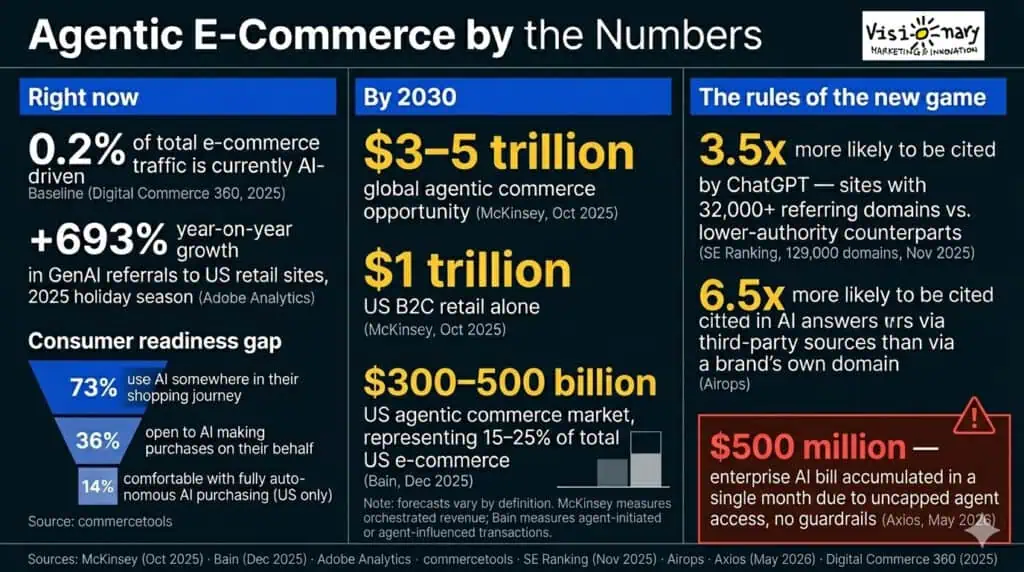
This view is supported by the data available. According to research by commercetools, 73% of consumers already use AI somewhere in their shopping journey. Yet only 36% are open to AI agents making purchases on their behalf. In the US, the figure for autonomous AI purchasing drops to 14%. The gap between AI as advisor and AI as buyer is vast, and it will narrow slowly.
The risks associated with agentic e-commerce are high
The risks of handing uncapped authority to an AI agent are no longer hypothetical. In late May 2026, an AI consultant reported to Axios that one of their enterprise clients had accidentally accumulated a $500 million bill on Anthropic’s Claude in a single month, simply by giving employees unrestricted access to the platform with no usage controls in place. Agentic workflows, which loop through tasks repeatedly, consume tokens at a rate orders of magnitude higher than a standard chat query. The bill was not the result of malicious use or a system failure. It was the predictable outcome of deploying autonomous agents without guardrails. The case is far from isolated: Uber reportedly exhausted its entire 2026 AI budget by April, with per-engineer costs running between $500 and $2,000 monthly. “You’ve got to be bold to give them no upper limit on transactions,” Hamilton observed, and the arithmetic proved him right.
[Editor’s note: I misquoted a similar anecdote about the Davos Summit during the interview. I’d heard or read this story in traditional media but couldn’t verify it with facts. I suspect it might have been fabricated. I replaced it with the above, duly sourced information.]
The check out must remain on the merchant’s platform
OpenAI itself learned this lesson when it launched Instant Checkout in September 2025, which allowed purchases to complete directly inside ChatGPT. By March 2026, the feature had been shut down. Brands rejected the model, citing the loss of traffic, customer data, and loyalty flows. Shopify’s own position makes the point clearly. At the Morgan Stanley Technology, Media and Telecom Conference in March 2026, Finkelstein noted that barely a dozen Shopify merchants were live on agentic commerce at the time. On the Q1 2026 earnings call, he was unambiguous: “LLMs do not bypass Shopify’s checkout.” The checkout, the payment flow, and the post-purchase relationship remain squarely on the merchant’s platform.
A natural segmentation
Hamilton sees a natural segmentationMarket segmentation is as important in B2B as in B2C. Strictly speaking, segmenting means dividing one's market into subsets (segments) emerging by category. Low-value, frequently purchased household items lend themselves to fully autonomous agentic purchasing. “I can totally imagine a portion of that marketMarket definition in B2B and B2C - The very notion of "market" is at the heart of any marketing approach. A market can be defined... occurring direct on an LLM,” he says. “Hey, I’ve run out of toothpaste, can you order me some?” High-involvement purchases, and anything with significant financial or emotional stakes, will retain human control over the final step for a long time yet.
The death of keyword search, greatly exaggerated
The brands Hamilton speaks with regularly are, understandably, worried. Most have spent the past two decades learning the rules of a game built around keyword search and performance marketing. That game has not ended, but the goalposts have shifted, and nobody is quite sure where they have moved to.

The scale of the agentic e-commerce shift
Key figures: the scale of the shift
- AI-driven sessions still represent below 0.2% of total e-commerce traffic, though they are the fastest-growing channel (Digital Commerce 360, 2025)
- GenAI referrals to US retail sites grew 693% year-on-year during the 2025 holiday season (Adobe Analytics)
- Gartner forecast that traditional search engine volume would drop 25% by 2026 as AI chatbots captured search share (Gartner, 2024)
- By early 2026, ChatGPT reached approximately 17% of global search queries against Google’s 78%
- Over 60% of Google searches now end without a click, across multiple industry studies
- Retailers with AI agent integration grew 32% faster during Cyber Week 2025 than those without (Salesforce)
Hamilton’s view on the fate of keyword search is careful rather than apocalyptic. Google will not lose its advertising revenues overnight. But the direction of travel is clear. Search queries will progressively migrate towards conversational interfaces, for the simple reason that we rarely know precisely what we want when we start looking. “We don’t necessarily know what we want 90% of the time,” he observes. “It takes a bit of a conversation to elicit exactly what we’re looking for.” Keyword search was always a crude proxy for intent. LLMs are, at least in principle, better placed to decode it.
Agentic e-commerce by the numbers
The question for brands is what to do about this. Hamilton’s prescription is structural rather than cosmetic. Brands need to become machine-readable, which means structured data connected to the right protocols, not just well-written product descriptions. Three open standards now define how AI agents interact with merchants: MCP (Model Context Protocol, originally developed by Anthropic and donated to the Linux Foundation in December 2025), ACP (OpenAI and Stripe, September 2025), and UCP (Google and Shopify, announced at NRF in January 2026). Shopify activated a default MCP endpoint for all its stores in Summer 2025. These are not optional extras. They are the new plumbing.
MCP, ACP or UCP and the agentic acronym soup
I raised with Hamilton the practical reality for most merchants, who have no idea what MCP, ACP, or UCP even stand for. His response was reassuring on one level, and sobering on another. Platforms like BASE are absorbing this complexity on behalf of their clients. A small or mid-sized retailer does not need to recruit data scientists or build protocol integrations in-house. They can, if they choose; the new generation of coding tools makes that more feasible than ever. But they can equally rely on an operational platform that handles those connections for them.
The sobering part comes when Hamilton acknowledges a concern he is genuinely uncertain about. Even if the protocols function perfectly, will LLMs be able to surface smaller independent brands alongside the big players with their vast content libraries and tens of thousands of referring domains? Research from Airops suggests that brands are 6.5 times more likely to be cited in AI answers through third-party sources than through their own domains. According to SE Ranking’s analysis of 129,000 domains, sites with more than 32,000 referring domains are 3.5 times more likely to be cited by ChatGPT than lower-authority counterparts. Scale, in other words, confers an advantage in AI visibility just as it did in paid search. The field may level in some ways; in others, it may simply tilt differently.
Operational excellence as the new marketing in this agentic e-commerce world
What AI agents actually evaluate
- Unlike Google’s search algorithm, which can be influenced by ad spend, AI agents query real-time signals: live stock levels, shipping terms, return policies, and customer review aggregates.
- Structured data across these dimensions is now considered standard for AI visibility by the major platforms.
- Retailers with AI agent integration achieved roughly 7x better sales growth during Cyber Week 2025 than those without (Salesforce).
Perhaps Hamilton’s most interesting claim, and the one most counterintuitive to marketers, is that operational excellence is becoming a direct marketing lever. An AI agent evaluating a recommendation does not care how much a brand has spent on Amazon retail media. It will scrape ten thousand reviews in half a second and draw its own conclusions about delivery reliability, return handling, and product quality. No media budget can substitute for that data trail.
“I think we’re heading to a world where operational excellence will count for more in the decision process,” Hamilton says, “and will be less easily brushed behind the curtains with a bit of ad spend.” This is, in theory, good news for consumers and for competent smaller operators who have always delivered well but lacked the budget to outrank wealthier rivals in paid search. Whether it will materialise in practice depends on whether LLMs can actually surface those operators when large brands flood the information environment with well-structured, high-quality content.
BASE France sits at exactly this intersection. The platform manages what it describes as the “spinal column” of an e-commerce operation: product catalogue management, order handling, marketplace feeds, stock synchronisation, and shipping. These are also, precisely, the data layers that AI agents query in real time when assembling recommendations. BASE connects to more than 1,700 integrations globally and serves some 30,000 merchants across more than 180 countries. In France, launched in early 2026 and operating from Bordeaux, the platform already counts 150 clients including Kiabi, Back Market, and Spartoo, with connections to around 250 marketplaces and partners.
The platform’s value proposition in an agentic world, as Hamilton frames it, is straightforward: merchants who want to be visible to AI agents need to expose the right data through the right protocols. BASE does that for them, whether or not a checkout ever happens inside an LLM.
The forecasts, the hype, and the rising tide
McKinsey estimates that agentic commerce could redirect between three and five trillion dollars in global retail spend by 2030, with up to one trillion of that in the US alone. Bain puts the US figure at 300 to 500 billion dollars, representing 15% to 25% of total US e-commerce sales. These numbers attract attention and, inevitably, scepticism.
Hamilton’s response is precise. He notes that global retail in 2030 will likely be somewhere around 50 trillion dollars. On that basis, the McKinsey and Bain figures imply that agentic commerce will account for somewhere between one and ten percent of total retail within four years. That is plausible, he suggests, if the definition of “agentic” is broad enough to include any transaction where an AI agent played a role somewhere in the funnel, from discovery to decision, not just cases where the checkout itself occurred on an LLM. Physical retail is not exempt either: a consumer standing in a supermarket aisle, consulting Gemini on their phone about which of two products is better, is already part of this story.
The honest summary is that we are watching a slow revolution rather than a tidal wave. “Maybe a year or two ago, some people made it sound imminent,” Hamilton reflects. “When it comes to retail, there’s still quite a lot of human behaviour inertia in the system. Things aren’t going to change drastically in the next twelve or twenty-four months. But over ten or fifteen years, it’s pretty difficult to imagine consumer behaviour and the retail experience looking anything like what it looks like today.”
Three priorities
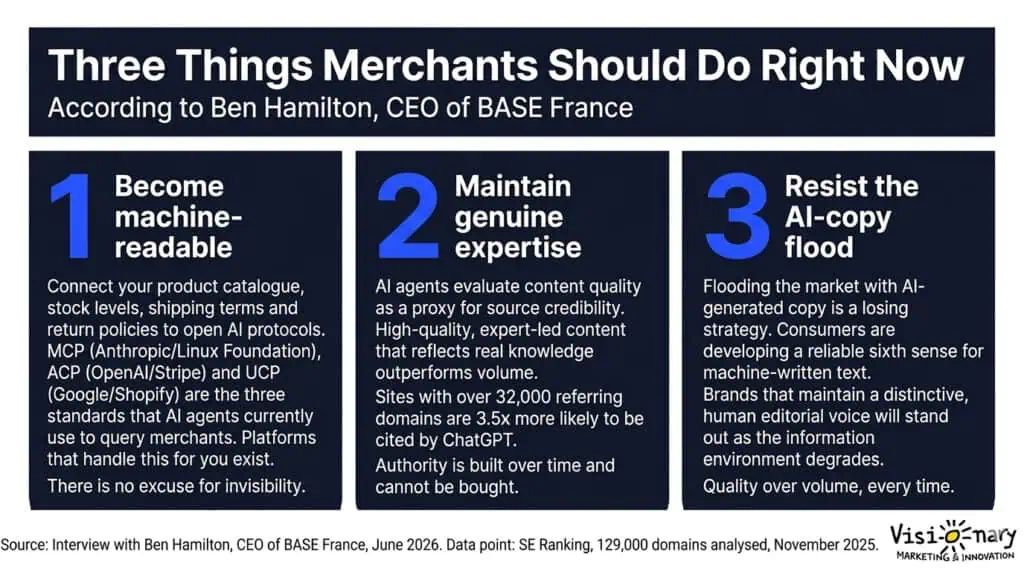
For merchants wondering what to do right now, Hamilton’s three priorities are:
- become machine-readable through structured data and protocol connections,
- maintain high-quality content that reflects genuine expertise,
- and resist the temptation to flood the market with AI-generated copy.
On that last point, he is candid. “Humans are starting to get pretty good at telling what is AI-generated and what isn’t. When you read things now, you almost have a sixth sense for ‘I think a machine wrote that.'” Good news, as I told him, for those of us who write for a living.
Infographic made with Gemini and Adobe Photoshop
The winners: a scenario Hamilton wants to believe
I asked Hamilton, as a final question, who he thought would win in this new landscape. Big retailers with scale advantages? Platform giants? Or the long tail of independent merchants who have always competed on product and service rather than budget?
His answer was honest about the limits of his own conviction. He described the scenario he wants rather than the one he necessarily expects. In that scenario, agentic commerce levels the playing field by reducing the influence of performance marketing budgets and increasing the weight of genuine operational quality.
“I like to believe that those who have superior products and superior service will get more and more traffic,” he said. Whether the reality will be so equitable depends on whether AI recommendation systems can overcome their own structural biases towards scale and data volume.
I was reminded, hearing this, of an IBM advertisement from the 1990s that showed an Italian woman selling her homemade spaghetti sauce to the world via the internet. The vision was real. The timeline was not. It took twenty years for that kind of global reach to become genuinely accessible to small producers. The analogy is imperfect but instructive. Agentic commerce will likely democratise access to markets over time. That time will be measured in years, not months.
Ben Hamilton and Base.com
Ben Hamilton is CEO of BASE France, the French arm of Base.com, a Polish-born e-commerce SaaS scale-up founded in 2006. With nearly two decades of expertise and a presence in more than 20 countries, Base serves approximately 30,000 merchants worldwide and generated €50 million in revenue in 2024. BASE France was officially launched in early 2026, operating from Bordeaux with a team of 20. The platform covers order management, stock synchronisation, shipping, marketplace feeds, and AI-ready product enrichment. Ben Hamilton is a regular speaker on the strategic implications of AI for e-commerce visibility and discovery.