How has sports officiating evolved over the past century, and what is the next step in the evolution of sports? Officials, or referees, are a crucial component of many sports, but are they really all that trustworthy? Can AI do a better job than humans, or are they prone to glitches and miscalculations? The history of AI in sports may date back further than you think. In this article we will be discussing the flaws of human refereeing and how AI can massively impact the world of sports for the better.
AI and the Future of Sports Officiating: Smarter, Faster, Fairer

AI in Sports
As a sports fan, there is nothing more infuriating than watching your favorite sports team lose because of a controversial call that an official has made. Now imagine a world where referees are able to make exactly the right call every single time.
AI has the power to do this and to completely change sports officiating. While technological advancements are being made and AI becomes increasingly powerful, the world of sports is changing for the better. Although AI has a long way to come, it is already making changes to how different sports are being officiated.
Why Sports Officiating Needs a Tech Upgrade
Traditional officiating depends solely on human judgement; this in turn leads to mistakes, fatigue, and subconscious bias. An AI officiating system could hyper-analyze games, maximize correct calls, and make completely objective decisions.
Many sports we know are extremely fast-paced and critical moments happen down to the millisecond. With an upgraded AI system, extensive amounts of data would be processed almost instantly, giving our referees every detail they need to make the correct decisions.
With data-backed rulings, fans can trust that our new and improved officials do not have any bias and that verdicts are solely objective. This will help with controversy issues as well as promote fair competitionMarket definition in B2B and B2C - The very notion of "market" is at the heart of any marketing approach. A market can be defined....
Being a sports official is not an easy job whatsoever. In England, 22% of football match officials have reported experiencing verbal abuse on a weekly basis. What’s even more shocking is that 19% of officials reported being physically assaulted.
The human eye can only see so much, and when athletes and balls are moving everywhere, it can be hard to keep up. Apparatus with multiple camera and video systems can use predictive modeling to make challenging, precise calls, such as offsides in soccer or close line judgements in American football.
Real World Example
Human referees at the end of the day are humans, and they have feelings. If someone or something upsets them, this can cause them to make calls that are not fair to the game.
Imagine flying across the country to your first ever NBA game to watch your favorite player get ejected from the game because of something as insignificant as laughing. Yup, in 2007, NBA player Tim Duncan was ejected from a basketball game because he was laughing.
This is an example of a sports official letting emotions get the best of him.

History of AI in Sports Officiating
Artificial intelligence’s tie to sports started in the early 1990s with American football teams using computer simulations to create game strategies and analyze player performance.
One of the first ever major uses of AI in sports, the Hawk-Eye (Hawk-Eye Innovations), made its debut in 2001 in a cricket match, using computer technology to track and predict the flight of the ball. Tennis later adapted a similar system to make close line calls in 2006.
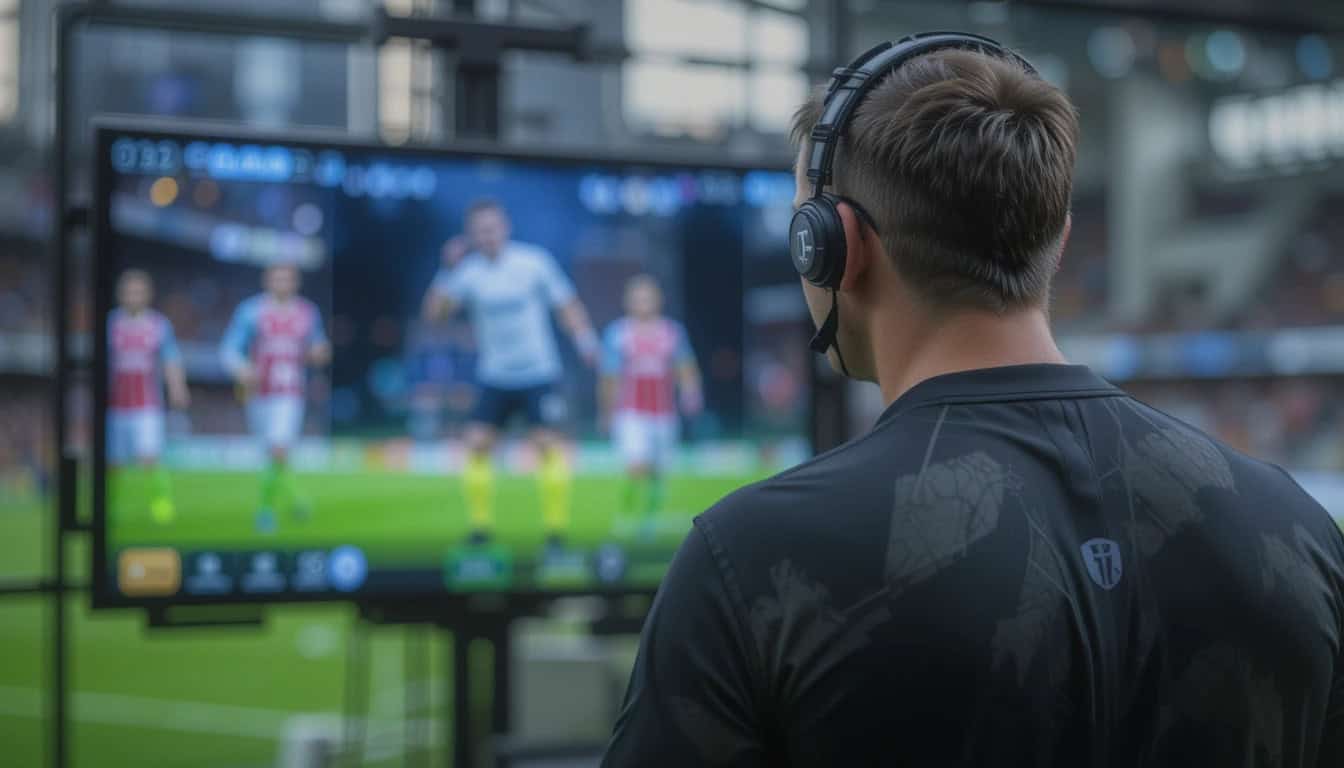
In 2016 the first-ever VAR (Video Assistant Referee) system was employed in a professional football game and used to verify goals, penalties, and red cards. From InsideFIFA, “While full VAR systems are geared towards processing a larger number of camera feeds, VAR Light systems are centered around smaller broadcast set-ups, with a maximum of eight cameras and a reduced technical arrangement as well as fewer operational requirements in the video operation room (VOR).”
Recent years
Semi-Automated offside technology launches in 2022 using 12 cameras to track players, their limbs, and ball movement. According to FIFA, “By combining the limb- and ball-tracking data and applying artificial intelligence, the new technology provides an automated offside alert to the video match officials inside the video operation room whenever the ball is received by an attacker who was in an offside position at the moment the ball was played by a team-mate.”
AI integration has come a long way, and many sports are taking advantage of these advancements. More recently, in 2023, the NBA partnered with Hawk-Eye technology to track in-game player movements and statistics such as speed and jump height.
Most world-recognized sports today use AI in some way or another, whether it be to make judgement calls or to analyze another team’s play style. AI is crucial to the evolution of sports.

AI’s Limitations and Controversies
At the end of the day, every sports fan has their own sets of values and opinions; not everyone wants the same thing. Some people may be all for the rise of AI in sports, while others may feel like it’s taking away from the “human element” of the game.
Human referees provide an emotional and instinctual side to sports that AI may not be able to replicate just yet. Referees are able to use real-time judgement, as well as control the environment and speed of the game; this adds a bit of individuality to each and every game based on different referees.
AI might be less prone to errors than humans are, but is it really that reliable? Technical glitches and inaccuracies still can and do occur. Not too long ago, in a Premier League match, VAR lines were incorrectly drawn, causing the referee to call an incorrect offside call. This cost the kicking team a pivotal goal in the match.
With AI officiating, accountability becomes confusing, if the AI makes an error, who is to blame? When a human referee makes a bad call, they are responded to by boos from the crowd and players yelling at them. If an artificially intelligent system makes a mistake, where will the blame go—to, the programmers, the league, or the data? This can leave fans aggravated without somewhere to unleash their anger.
The Future: Will AI replace human refs?
The idea of fully AI referees does not seem as crazy as it once may have. AI technology is growing at a very fast pace, but are we ready to fully replace referee?. A better question might be, should we fully replace referees?
The problem with fully replacing sports officials with AI is that there is more to being an official than calling fouls and making line judgements. A sports official’s job is to manage the game, something AI is not ready to do.
Sports officials communicate with the players, coaches, and stat keepers; they manage emotions, break up fights, and control the pace of the game.
What we can see in the future is a more mixed approach taking the pros of both human referees and AI-powered call-making. We have already seen this start to take place with implementations like the VAR or Hawk-Eye.
This mixed approach will allow AI to make clear-cut factual calls such as out-of-bounds, fouls, and offsides. The humans will make more judgement based calls, such as intentional fouls, and unsportsmanlike behavior, as well as manage the flow of the game.
Conclusion
As the future unfolds, AI will continue to grow and to become more powerful. There is a clear problem that needs solving, and that is that human referees need some help. Although an AI solution might cause problems or controversies, it has a lot of benefits as well.
While AI continues to help out different sports and different teams, it has a long way to come to replace our referees. The true objective is to make these sports more fair and safe, and AI might just be the answer. Sports officials and AI can and will be great teammates and change the future of sports for the better.
Check out our Business in Sports section for more articles.